
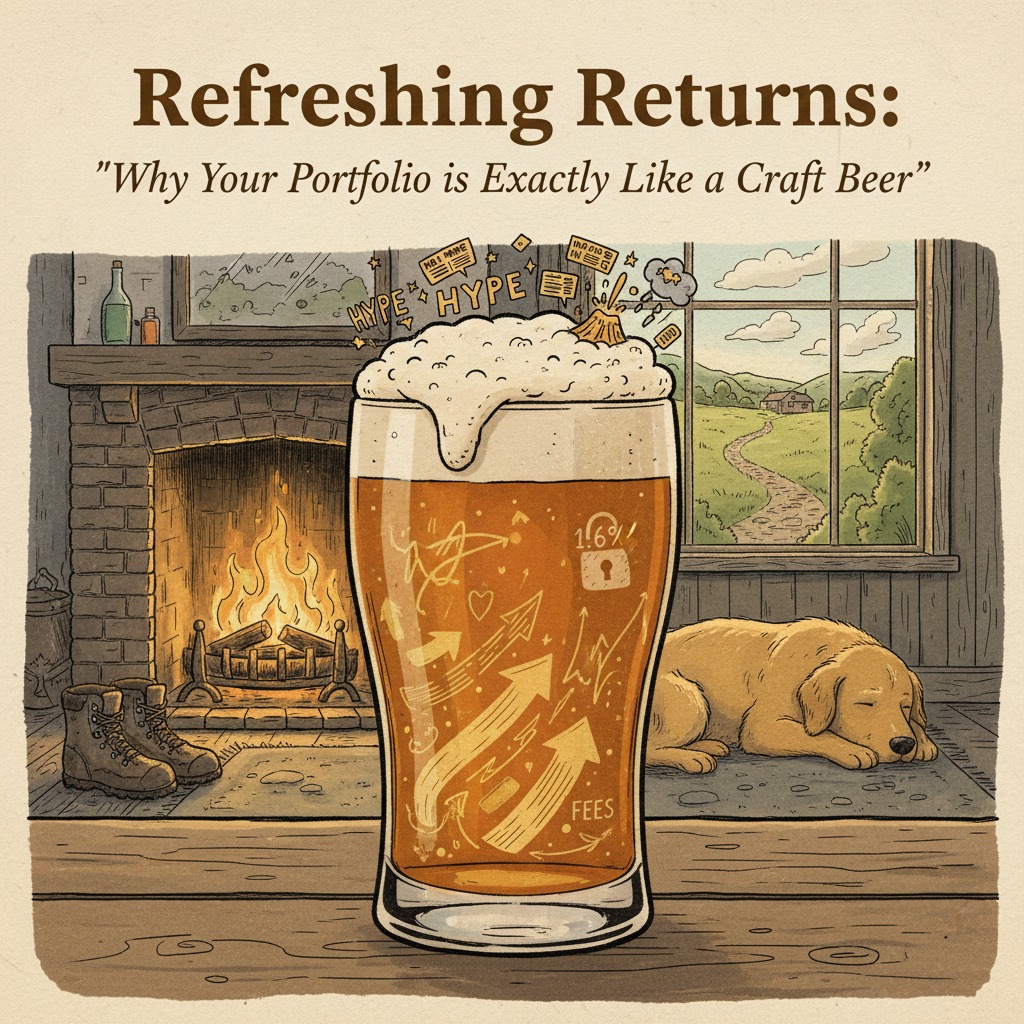
There is a specific kind of satisfaction that only comes after a long walk through the British countryside. You know the one—where your boots are caked in a questionable amount of mud, your legs have that pleasant, heavy ache, and the pub at the end of the trail feels less like a building and more like a sanctuary.
I was sitting in exactly that kind of spot recently. A quiet corner, a roaring fire, and a pint of something cold.
For a moment, I thought about the “Pear Cider” version of myself. I liked the idea of it—the sweetness, the niche appeal, the slight “edge” over the standard lager drinkers. But there was a problem. Every time I indulged in the flashy stuff, I ended up with a metaphorical (and literal) allergic reaction. My system just couldn’t handle the complexity.
Some people spend decades trying to force themselves to like the “flashy” stuff, but I’ve never been one to enjoy banging my head against a brick wall. I was quick to see the mistake for what it was. I saw the froth, I saw the noise, and I got on the simple path before the “allergic reaction” could do any real damage.
These days, I’m much happier with the “House Pour.”
The Anatomy of a Pint: Core, Foam, and Hype
When you look at a freshly poured pint, you see three things: the beer, the glass, and the foam. Your portfolio is exactly the same, and if you don’t know which is which, you’re going to end up thirsty.
The liquid—the actual beer—is your real return. It’s the substance. It’s the part that actually does the work of quenching your thirst for Financial Independence.
Then, there’s the foam.
In a pub, a little head on the beer is a sign of a good pour. In the markets, however, that foam is made of “Noise.” It’s the froth generated by government shifts, sudden volcanic eruptions halfway across the world, or global pandemics that no one saw coming. It’s the “Hype” that makes the glass look fuller than it actually is.
I’ve seen people try to “drink” the foam. They buy into the hype when the head is six inches high, thinking they’re getting more for their money. But as soon as the noise settles—as soon as the volcano stops smoking or the news cycle moves on—the foam evaporates. They’re left with half a glass of actual substance and a lot of regret.
If you want refreshing returns, you have to learn to look past the froth and focus on the liquid underneath.
The Thick Glass Problem (The Hidden Fee Trap)
This is the part that usually gets me fired up, and it’s where most “casual” drinkers get caught out.
Imagine you walk into a pub and order a pint. The bartender hands you a glass that looks sturdy and impressive. But when you start drinking, you realise the glass is three inches thick. The walls of the vessel are so wide that there’s barely any room for the actual beer.
In the world of finance, that thick glass represents Fees.
Before I simplified and found the Slow Burn style of investing, I was drinking out of a very thick glass indeed. I was paying roughly 1.6% in management fees. At the time, it didn’t seem like a disaster. It was just a small percentage, a tiny “service charge” for the experts, right?
Wrong.
To show you why I pivoted so quickly, look at what happens when the “Glass Maker” takes their cut over a 30-year career. If we assume a starting pot of £50,000 and a 7% market return:
| Year | The “House Pour” (0.2% Fee) | The “Thick Glass” (1.6% Fee) | The “Fee Thief” (Loss) |
| 0 | £50,000 | £50,000 | £0 |
| 10 | £96,444 | £84,180 | £12,264 |
| 20 | £186,029 | £141,725 | £44,304 |
| 30 | £358,843 | £238,629 | £120,214 |
That 1.6% “thick glass” didn’t just take a sip; it drank over £120,000 of my hard-earned beer. That’s not a fee; that’s a heist. The thinner the glass, the more liquid gold stays where it belongs: in your pocket.
Diversifying the Hops: Good vs. Perfect
We’ve all met the “Beer Snob.” The person who won’t touch a pint unless it was brewed in a bathtub in East London using hops hand-picked by monks.
In investing, this is the person chasing the “Perfect” portfolio. They want the one that beats the market every single year. They want the “Secret Sauce” that will make them the smartest person in the room.
Here is the truth: to find a “Perfect” investment, you’d need to be able to see into the future. You’d have to hand-pick every single company with 100% accuracy to beat the market year on year. It’s exhausting, it’s stressful, and it usually leads to that “allergic reaction” I mentioned earlier.
I’ve learned that Good is better than Perfect.
A solid, low-cost global index fund is like a masterfully blended beer. It uses hops from all over the world—companies that operate globally, across different sectors and borders. By diversifying your “hops,” you aren’t betting on one single plant to survive the winter. You’re betting on the entire harvest.
You aren’t trying to beat the market; you are simply meeting the market. And when the market has historically grown over time, meeting it is more than enough to get you to the pub at the end of the trail.
The Slow Pour: Patience in a Fast-Paced World
If you try to pour a beer too fast, you get nothing but foam. You end up with a mess on the counter and a glass full of air.
Investing is the same. People try to “rush” their way to wealth by dumping everything in at what they think is the “right” time or chasing the latest trend. Usually, they just end up with a face full of froth.
I prefer the Slow Pour. In the industry, they call it Dollar Cost Averaging, but let’s just call it “Consistent Sipping.”
You keep pouring, month after month, regardless of whether the news is talking about volcanoes or elections. Some months, there might be a bit more foam (the market is volatile). Other months, the pour is clean and the liquid fills up fast.
But because you don’t stop, and because you aren’t trying to time the “perfect” head on the beer, you eventually end up with a full, solid, refreshing pint. It’s not about speed; it’s about the steady hand.
Settling for the House Pour
I don’t miss the pear cider. I don’t miss the 1.6% fees or the stress of trying to be a “specialist” in something that is inherently unpredictable.
There is a deep, quiet peace in settling for the “House Pour”—the reliable, boring, low-cost global index fund. It doesn’t cause an allergic reaction. It doesn’t require me to check my phone every ten minutes to see if the world is ending.
It just sits there, fermenting, getting better with age, while I get on with the things that actually matter—like finishing this walk and enjoying the fire.
Gentle Questions for the Road
As I sat there by the fire, watching the last of the foam settle on my glass, I realised that most of the stress in our lives comes from trying to make things more complicated than they need to be. We think that if something is “simple,” we must be doing it wrong. We feel like we should be “doing more.”
But the best things in life—a good walk, a warm fire, a solid investment—don’t actually require us to interfere with them constantly. They just require us to show up, choose wisely, and then have the patience to let the process happen.
Questions:
- How “thick” is the glass you’re currently drinking from? Have you checked your fund fees lately to see if you’re paying for the “House Pour” or the “Glass Maker’s” lifestyle?
- Are you distracted by the “foam”? When the news gets loud, do you find yourself wanting to change your plan, or can you look past the froth to the liquid returns?
- What would change if you stopped trying to “beat” the market and simply committed to “meeting” it? How much headspace would that free up for your actual life?
To Low-Cost Index Funds. Cheers.