
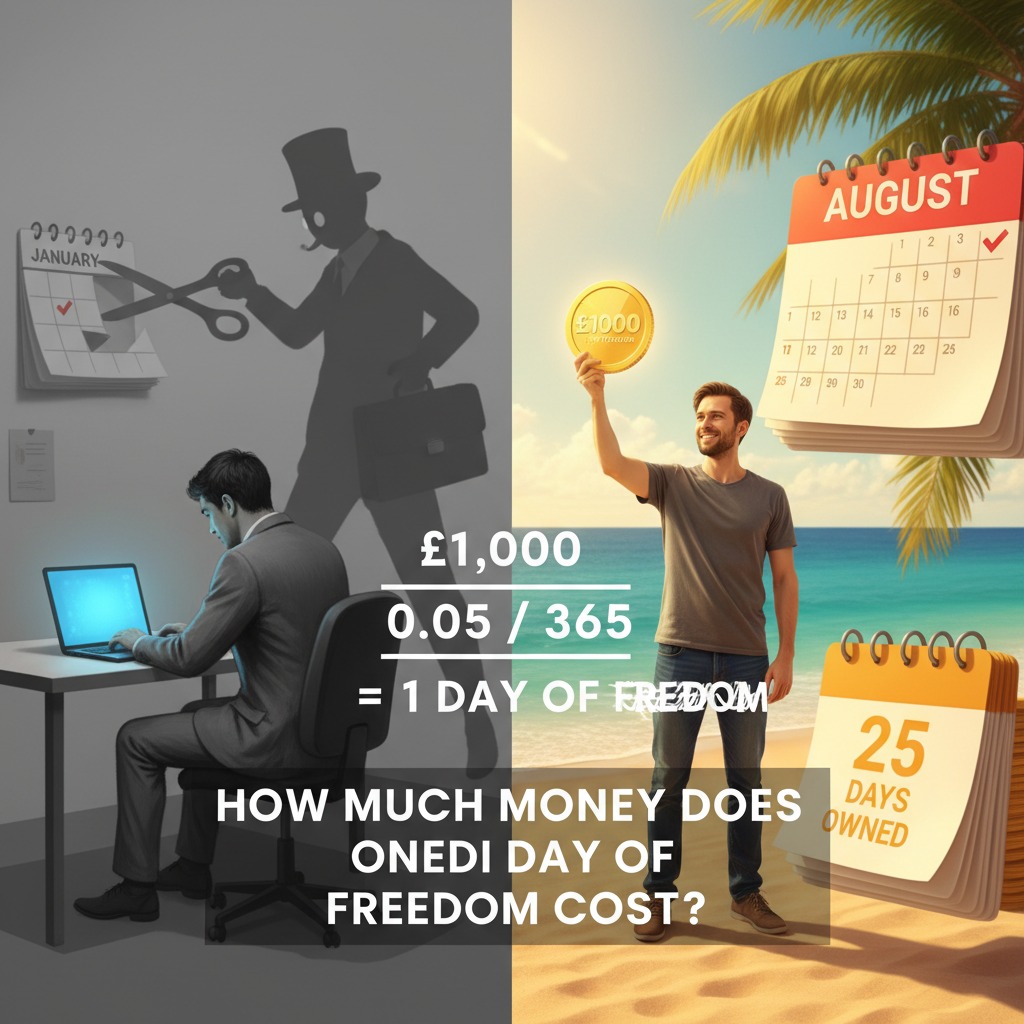
The particular kind of quiet madness that settled in this February. It wasn’t born of the grey skies or the lingering chill; it was a madness of pure math wizardry. There I was, sitting at my desk, the glow of the dual monitors humming in my ears, and I realized—with the sudden clarity of a cold shower—that I haven’t actually started working for myself yet this year.
If you look at your payslip with the eyes of a math nerd, you’ll see the ghost of a silent employer. From New Year’s Day until somewhere deep into March, you are essentially a high-functioning, caffeine-depleted civil servant. Every email you send, every “synergy” you create, and every spreadsheet you populate is effectively a gift to the government to settle your tax bill.
It was during one of these moments—staring at my own payslip while my boss likely thought I was “circling back” on a project—that the question hit me: If I’m working the first three months of the year for the taxman, how many days am I actually working for me?
And more importantly, how much does it cost to buy one of those days back?
The Big Number Trap for Freedom
We’ve all seen the Financial Independence calculators. You plug in your expenses, hit enter, and a number like £600,000 or £1.2 million flashes up on the screen.
It’s a mountain. A massive, snow-capped, oxygen-deprived peak that feels entirely disconnected from a rainy Tuesday morning in a grey office. When the goal is that big, it feels theoretical. It feels like a “someday” that might never happen, so we stop trying. We lose the thread.
But what if we stopped looking at the mountain and started looking at the calendar? What if, instead of aiming for “The End of Work,” we just aimed to buy next Tuesday?
This is where we stop being victims of the “hustle” and start becoming owners of our hours. For those of us in the £10k–£50k bracket, we aren’t at the finish line yet. We are in the thick of the accumulation phase. Our systems are set up, our direct debits are firing, and we are simply putting in the reps. But sometimes, the “growth stage” needs a bit of a psychological rebrand to keep the fire lit.
The Math Wizardry: How to Buy a Day of Freedom
To make this work, we have to embrace a bit of Slow Burn philosophy: Perfection is the enemy of great. We could spend weeks arguing over inflation rates, dividend yields, and the exact decimal point of a Safe Withdrawal Rate (SWR). Or, we could just pick a number that works and get on with the mission.
I’ve settled on a 5% Safe Withdrawal Rate.
Because I plan to keep working my current job for a while—and eventually transition into something with a bit more “organised fun”—5% feels like a solid, motivating baseline for this specific calculation.
The Formula
Here is how you calculate the price of your freedom:
- Take your annual expenses. 2. Divide by your SWR (0.05). 3. Divide by the days in a year (365 or 260). For me, the math aligned with beautiful simplicity: Every £1,000 I invest buys me one day of freedom. Every. Single. Year. Forever.
The Working Day Variation: Depending on your journey, you might prefer different numbers. If you want a high-level view of your entire life, use 365 days. But if you’re aiming to delete the 9-to-5 grind specifically, dividing by 260 (working days) makes more sense. It tells you exactly what it costs to buy back a Monday.
Suddenly, that £1,000 payment into your ISA isn’t just “savings.” It’s a 24-hour voucher. It’s a day where no one can tell you what to do, what to wear, or which “mandatory fun” Zoom quiz you have to attend.
My 25-Day Freedom Portfolio
Currently, I am sitting on 25 days of freedom.
In the grand scheme of a 365-day year, 25 days might sound small. It’s less than 10%. But in the world of the Slow Burn Club, 25 days is a triumph.
It means that every two months I spend in the “grind,” I am purchasing more than a day of my life back. I’m not just working to pay the mortgage; I’m working to shrink the portion of the year that belongs to someone else.
When you look at your portfolio this way, the £10k–£50k range stops being the “boring middle” and starts being a collection of weeks.
- £10,000 = 10 Days.
- £30,000 = a full month of freedom.
- £50,000 = nearly two months where you are effectively your own boss.
It turns the abstract into the tangible. It makes that next £1,000 deposit feel like a victory lap rather than a chore.
The August Deletion
If I were to “spend” my 25 days all at once, I know exactly where they would go.
I’d delete August.
There is something about August—the way the season starts to ever-so-slightly cool, the light turns golden, and the flights suddenly become a bit more reasonable. It’s the month where you want to be outside, breathing air that hasn’t been recycled through an office HVAC system.
Imagine waking up on August 1st knowing that the entire month is yours. You’ve bought it. You’ve paid the “Freedom Tax” in advance.
The mid-double-digit temperatures we’re seeing this February are a teaser for that feeling. It’s the season where you can finally leave the “Arctic-level protection” coat in the cupboard and just walk. No alarms, no commutes, just 24 hours of autonomy that you own outright.
Why Simplicity Wins
We live in a culture that loves to overcomplicate things. We are told we need complex “wealth management” strategies and a 12-step plan to optimize our lives.
It’s all noise.
The truth is that simplicity is a superpower. When you settle on a number like “£1,000 = 1 Day,” you silence the noise. You stop worrying about whether the market is up 2% or down 3% this week. Instead, you focus on the milestone.
- Did I hit another £1k this month?
- Yes?
- Great. I just bought next Wednesday.
It grounds the accumulation phase. It makes the £10k-£50k bracket feel like a series of small, achievable wins. You don’t need a guru to tell you how to reclaim your time. You just need a laptop calculator and the willingness to see your money for what it really is: stored energy. You are trading your current energy (work) for future time (freedom). And at £1,000 a pop, the price of admission is a lot more tangible than a million-pound mountain.
Gentle Questions for the Road
As the weather starts to shift and we see those mid-double-digit temperatures peaking through the February gloom, I find myself reaching for the lighter coat. There’s a sense of anticipation in the air—a feeling that the “taxman months” are nearly over and the “me months” are beginning.
There is a quiet joy in knowing that even while I’m doing the work, a small portion of my future is already settled. Those 25 days are sitting there, waiting for me, like a gift I’ve sent to my future self. It’s not about escaping life; it’s about owning it, one day at a time.
Reflections for you:
- If you could “delete” one month from your working calendar using your Freedom Days, which one would it be?
- What is your “Freedom Number”? If you divide your big goal into £1,000 chunks, how many days do you already own?
- When you look at your last payslip, does the “Taxman’s Quarter” (Jan-March) motivate you to buy back your April?