
I am currently sitting in a corner of a local café, and I am fairly certain I am vibrating.
It’s the third latte. The “recovery” part of my recovering-overachiever status usually involves a bit more zen and a bit less caffeine-induced heart palpitations, but today we’re talking about compounding. And nothing makes my brain buzz quite like the Great Illusion of the hockey stick graph.
We’ve all seen it. That smooth, elegant curve that starts at the bottom left and sweeps majestically to the top right. It looks so peaceful. So inevitable. It suggests that if you just tuck away your £100 a month, you will eventually glide into a sunset made of gold coins and early retirement.
But here is the truth they don’t put in the brochures: Compounding makes absolutely no sense when you’re actually doing it.
It is confusing at the beginning, it is a void in the middle, and it is a total emotional gut punch at the end. Our human brains are hardwired for linear progress. We understand that if we walk for an hour, we’ll be four miles away. We do not understand a system where we walk for three years and appear to have moved exactly four inches—only to wake up in year ten and find we’ve been teleported to Mars.
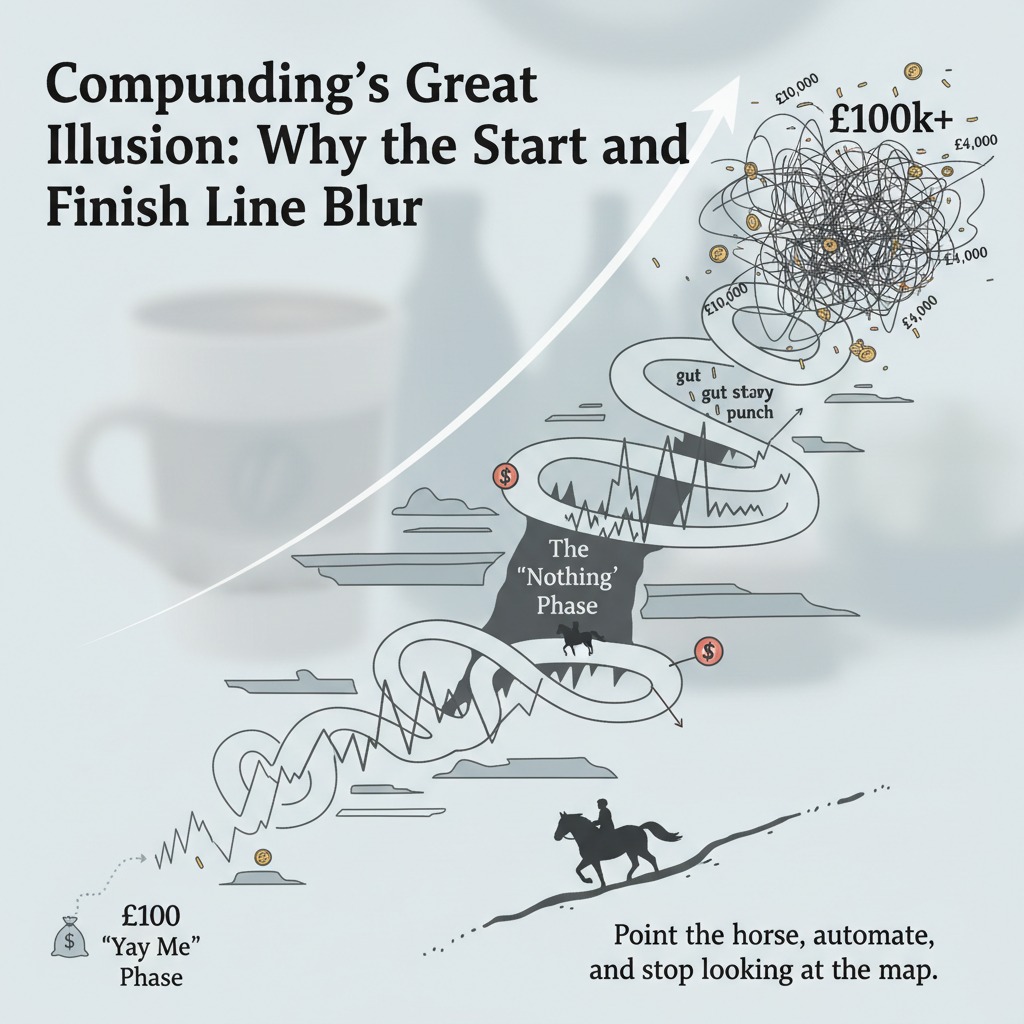
The £100 “Yay Me” Phase
When you first start investing—maybe you’ve just opened your first ISA or you’re finally looking at that workplace pension—you feel like a hero. You move £100 from your current account. You feel the weight of that sacrifice. That’s a nice dinner out, or a decent pair of shoes, or half a grocery shop in today’s economy.
You check the app a month later. You have £100. Maybe £100.40 if the wind was blowing the right way.
“Yay me,” you whisper, with only a hint of sarcasm.
This is the “Bean Bag” phase of life. You are standing in front of a hoop, throwing bean bags, hoping they land. But the hoop is miles away, and you can’t even see if you’ve scored. You put in 100, your balance goes up by 100. You put in another 100, it goes up by 100.
Where is the magic? Where are the “earnings”?
At this stage, compounding is invisible. It feels like a basic savings account with extra steps and more risk. This is the danger zone where most people quit. They get “spooked.” They see a headline about a market dip, look at their hard-earned £1,200 that is now somehow £1,150, and they bin the whole thing.
The only cure for the “Nothing” phase is automation. You have to point the horse in the right direction, slap it on the flank, and stop looking at the map. If you don’t automate it, your brain will talk you out of it every single time.
The 7% Lie and the Post-Property Slump
We need to talk about the “7% average return” myth. In our hypothetical conversations with ourselves (the kind of nerdery I specialise in), we treat 7% like a steady escalator.
In reality, 7% is a drunk person on a trampoline. It’s actually -30% one year and +25% the next. It’s a wild see-saw that eventually, over decades, averages out to something useful. But when you’re at the start, that volatility feels personal.
I felt this most acutely after buying my flat. You spend years saving for that deposit, you finally “win” the game of UK real estate, and then you look at your investment pots. They are empty. You’re starting from scratch. It has taken me over a year of consistent “bean bag throwing” just to see any semblance of growth that wasn’t just my own deposits.
It’s soul-destroying to be a “wealthy” homeowner on paper but a financial toddler in your ISA. You’re back in the “Nothing” phase, waiting for the horse to actually start moving.
The Monopoly Phase: Vertigo at £100k+
Now, let’s skip the middle (because nobody wants to talk about the boring bit where you just work and wait) and look at the “Finish Line.”
You’d think that once you hit the six-figure mark, everything would feel stable. You’ve reached the “Shaft” of the hockey stick. The numbers are big. You are officially a “Money Nerd” success story.
But this is where the second illusion kicks in.
At the end, compounding isn’t just confusing; it’s insane. You reach a point where your daily market fluctuations are larger than your monthly salary. You wake up on a Tuesday, check your phone, and see that you’ve “lost” £10,000.
That is a “gut punch.” There is no other word for it.
Even if you know the math—even if you know it will likely swing back up by next Thursday—your brain cannot compute the loss of a mid-sized family car while you’re eating your morning toast. It feels like owning all the hotels in Monopoly. You have the assets, you have the “wealth,” but you’re constantly paying out “taxes” to the market.
Real-world money starts to feel like a simulation. You hesitate to buy a £4 latte (vibrations notwithstanding), yet you watch £4,000 vanish in an afternoon without blinking. The scale of the movements becomes so extreme that you lose your sense of North.
Forget the Hockey Stick, Buy a Horse
The problem is that we are obsessed with the curve. We want the “Hockey Stick” because it looks controlled. It looks like a plan.
I’d rather draw you a picture of a horse.
Investing is a horse. You can train it, you can feed it, and you can try your absolute best to point it toward the destination. But once you’re in the saddle, the horse is going to do what the horse wants to do. Some days it’ll gallop (the +20% years), some days it’ll stop to eat grass for three years (the “Nothing” phase), and some days it’ll get spooked by a plastic bag and try to throw you into a ditch (the £10k gut punch).
The “Great Illusion” is thinking you are the one in control of the speed. You aren’t. You are only in control of the direction.
The Mindful Pivot
Whether you are staring at your first £100 or your last £100,000, the confusion is the same.
- At the start, you’re confused because the effort doesn’t match the result.
- At the end, you’re confused because the result doesn’t match your reality.
The trick is to stop expecting it to make sense. We aren’t built to understand exponential growth; we’re built to understand “I pick a berry, I have a berry.”
So, automate the bean bags. Accept the gut punches. And for heaven’s sake, if you’re already vibrating from the coffee, stop checking the Vanguard app.
Gentle Questions for the Road
As the seasons shift, I find myself thinking about how much of our lives we spend waiting for the “Blade” of the hockey stick to turn upward. We plant seeds in the garden and expect flowers the next day. We start a new habit and expect a new identity by Friday.
But life, much like my vibrating coffee habit, doesn’t move in a straight line. There are seasons of “nothing happening” that are actually seasons of deep, underground rooting. Whether you’re mourning a £10k dip or celebrating a £10 deposit, remember that the horse is still moving, even when it’s just walking.
- Where are you currently in the “Nothing” phase? Is there an area of your life (health, money, or a hobby) where you’re throwing bean bags but haven’t seen a score yet?
- How do you handle the “Gut Punch”? When things you’ve worked for take a temporary dip, what is your go-to move to stop yourself from getting “spooked”?
- Is your horse pointed in the right direction? If you stopped looking at the daily fluctuations, would you still be happy with where you’re headed?