
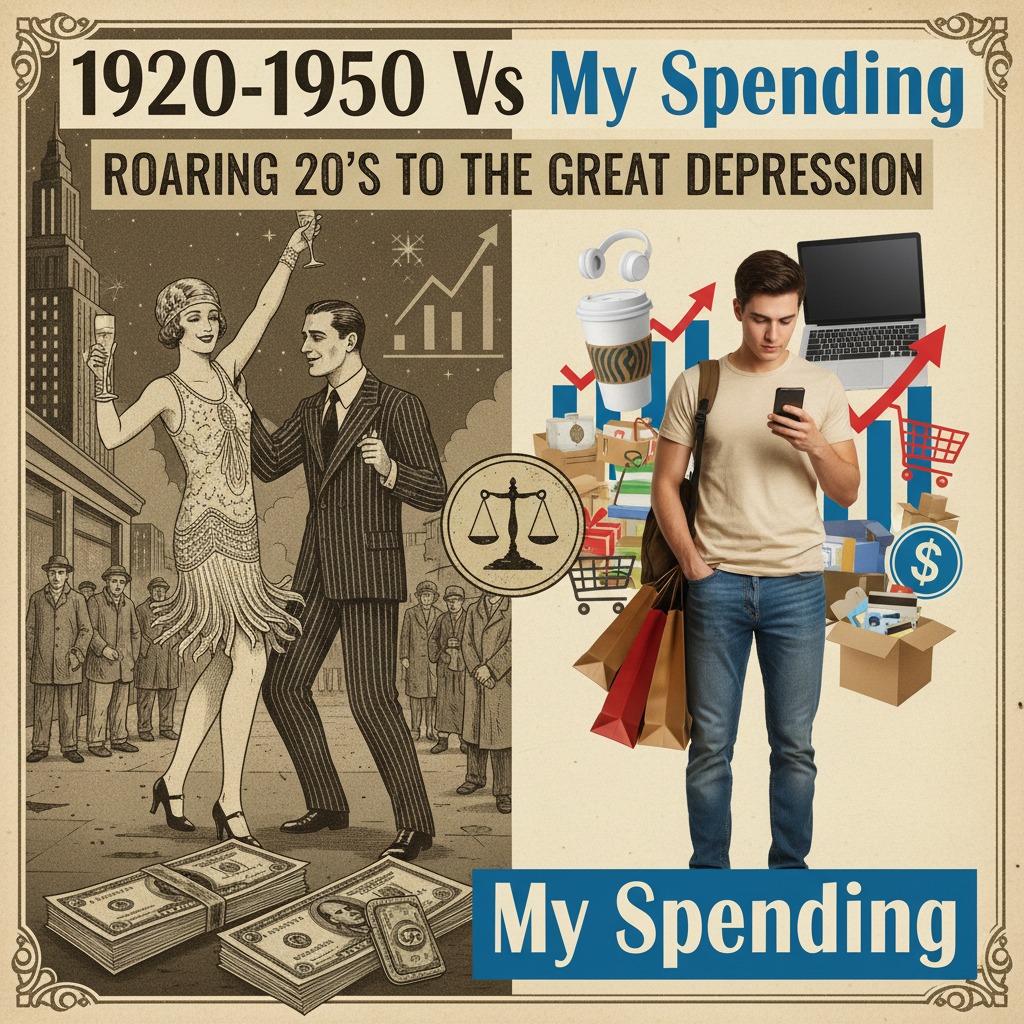
Continuing our journey through the century’s ledgers, we arrive at a fascinating forty-year block. Looking at the years 1920-1950, we cover an astonishing amount of historical whiplash.
This era spans the jazz-soaked Roaring Twenties, the devastating 1929 Wall Street Crash, the gritty reality of the Great Depression, the rationing of the Second World War, and the dawn of post-war rebuilding.
You would expect the average household budget to swing wildly through such chaotic decades.
Strangely, it barely flinched.
Comparing my modern pursuit of Financial Independence to these four decades reveals a stark reality. For forty years, through booms and busts, the average household savings rate sat completely flat at zero.
Here is exactly how the numbers look side-by-side.
The Zero Savings Decades
| Category | 1920 | 1930 | 1940 | 1950 | My Current Spending |
| Housing | 18.0% | 20.0% | 18.0% | 20.0% | 12.5% |
| Food | 40.0% | 38.0% | 42.0% | 35.0% | 10.0% |
| Transport | 4.0% | 5.0% | 6.0% | 7.0% | 3.0% |
| Clothing | 6.0% | 5.0% | 5.0% | 5.0% | 2.0% |
| Utilities | 12.0% | 12.0% | 11.0% | 13.0% | 8.0% |
| Household Goods | 5.0% | 4.0% | 4.0% | 4.0% | 1.0% |
| Leisure & Recreation | 12.0% | 12.0% | 10.0% | 12.0% | 15.5% |
| Savings / Investments | 0.0% | 0.0% | 0.0% | 0.0% | 39.0% |
| Other | 3.0% | 4.0% | 4.0% | 4.0% | 9.0% |
The Drawer-Cot and the Myth of the Golden Age
It is incredibly tempting to look back at the past and assume people were financially better off. We hear stories of single-income families buying houses and assume it was a golden age of easy money.
The reality of 1920-1950 was far more gritty.
My granny was born just a month before the Second World War started. They kept things remarkably simple because there was simply no other choice. She slept in a drawer, not a meticulously researched, ergonomic cot.
She tells stories of playing around sea mines on the beach when the tide went out. They shared bedrooms with siblings, made do with whatever they had, and were entirely happy doing it.
They weren’t richer back then; they just lacked the modern mechanisms of debt.
There were no credit cards or handy overdrafts. You could physically feel exactly how much cash you had left in your pocket until payday. It is a brilliant, natural boundary against lifestyle creep.
I used a similar tactic back at university. Taking only physical cash on a night out was the simplest way to ensure I couldn’t overspend—and a highly effective method for not over-taxing my liver. Modern consumerism relies on invisible money to make us part with it easily.
The Great Wealth Transfer: Did Cheaper Food Make Housing Expensive?
Looking closely at the data across 1920-1950, a quiet economic shift starts to reveal itself. Food costs dominate the ledger, hovering around 40% before slowly trending downward to 35% by 1950.
Today, my food costs sit at just 10%.
Where did all that freed-up capital go? Looking at the modern UK economy, it seems the property market simply swallowed it whole.
As agricultural efficiency improved and transport networks expanded, distributing food became cheaper. This is clearly visible in the data: as food drops slightly, transport slowly creeps up from 4% to 7%.
But as survival became cheaper, our expectations for housing grew. We stopped cramming multiple generations into small homes and stopped putting babies to sleep in drawers. The market happily absorbed the difference, driving housing prices ever upward.
My Ex-Council Cheat Code
While housing swallowed the savings of the average modern Brit, I actively guard against it. My housing costs sit at a comfortable 12.5%, well below the 18-20% our ancestors paid.
This is largely down to one highly intentional choice: an ex-council flat.
We bought a solidly built property with lower service charges, deliberately staying within a budget that allows us to survive on a single salary if the worst happens. It sits a 45-minute walk—or a 20-minute bus ride—from my parents, keeping us close to family without the premium price tag.
The peace of mind this brings is immense. While the news cycle endlessly panics about interest rates, I don’t lose sleep over it.
We saved a hefty deposit upfront and have built enough equity that I know our monthly payment will actually go down when we next remortgage. Structuring your housing to require less of your energy is the ultimate modern cheat code.
1920-1950 Transport Creep & The “Room, Not the Building” Rule
Between 1920 and 1950, transport costs steadily ticked upward by about 1% every decade. Cars were slowly shifting from a luxury for the wealthy to a middle-class aspiration.
Today, my transport costs sit stubbornly at 3%.
Living in a well-connected public transport network is a massive advantage. I don’t own a car, avoiding the endless drain of insurance, depreciation, and MOTs. It is another quiet victory that keeps my outgoings low.
Then there are the utilities. From 1920-1950, households spent 11-13% of their income on utilities, largely driven by the relentless need to keep coal fires burning just to stave off the damp.
My utilities sit at 8%, largely thanks to simple common sense.
Instead of firing up the central heating to warm the entire building, I use a portable heater to warm the specific room I am sitting in. This is highly practical, especially given my partner’s absolute insistence on throwing the windows wide open for fresh air regardless of the season.
Why a 0% Savings Rate Was Normal (And Why I Save 39%)
For four decades, through the dizzying heights of the Roaring 20s and the crushing lows of the 1930s, the average savings rate was non-existent.
Social mobility was incredibly low. The standard retirement plan was simply to work until you physically couldn’t, perhaps relying on a very small pension or family support in your final years.
When the stock market crashed in 1929, it didn’t decimate the investment portfolios of the average working-class family, because they didn’t have any. It affected their livelihoods instead. It meant job losses, pay cuts, and scraping by.
Today, my savings and investments consume 39% of my income.
It is a staggering privilege. But it is also a choice to actively use the margins of the modern world—cheap food, public transport, ex-council housing—to build a wall of security around my little family.
Yet, even with a high savings rate, life still needs to be lived. Through a Depression and a World War, the households of 1920-1950 still directed around 12% of their money toward leisure. They went to the cinema, the pub, and dance halls.
I allocate 15.5% to leisure and recreation, mostly focused on holidays and gathering with friends. Pursuing Financial Independence is only worth the effort if you actually enjoy being young while you are doing it.
Gentle Questions for the Road
It is strange how looking at decades defined by global turmoil can actually make you feel more grounded. When I step out of the ex-council flat and take a walk on the commons, I rarely think about interest rates, the 1929 market crash, or my 39% savings rate.
I just look at the trees and the flowers. There is a deep, quiet peace in knowing you have structured your life to simply tick along without requiring constant financial panic. The ghosts of the 1930s managed to find joy playing on sea mines and sharing bedrooms; we can certainly find it on a free walk through the park.
- When you look at your own essential expenses, how much of your budget is driven by “modern expectations” rather than true necessity?
- Is there a physical boundary you could put in place (like using cash on a night out or heating just one room) to gently curb your spending?
- Where do you find your equivalent of “playing on the beach”—the entirely free, simple things that bring you a sense of peace?