
There is a specific kind of madness that takes hold when you first discover Financial Independence. It usually involves a laptop balanced on your knees at 11:00 PM, sixteen open tabs of historical market data, and a spreadsheet so complex it looks like it’s trying to launch a satellite.
I’ve been there. In my early days, I was a bit of a “return chaser.” I was so focused on the shiny promise of big gains that I completely ignored the plumbing. I ended up in accounts with 1.6% fees—yowzer. Looking back, that wasn’t just expensive; it was a quiet theft of my future time. It took me a year to realise that I was essentially paying for a fund manager’s second home while they consistently failed to beat a basic index.
Luckily, I caught it and moved to the “quiet side” of investing. What I realised is that you don’t need to be a math wizard or a day trader to find peace. You just need to master four specific percentages. These are the dials on your dashboard. Once you set them, you can close the laptop, pick up a book, and let the slow burn do its work.
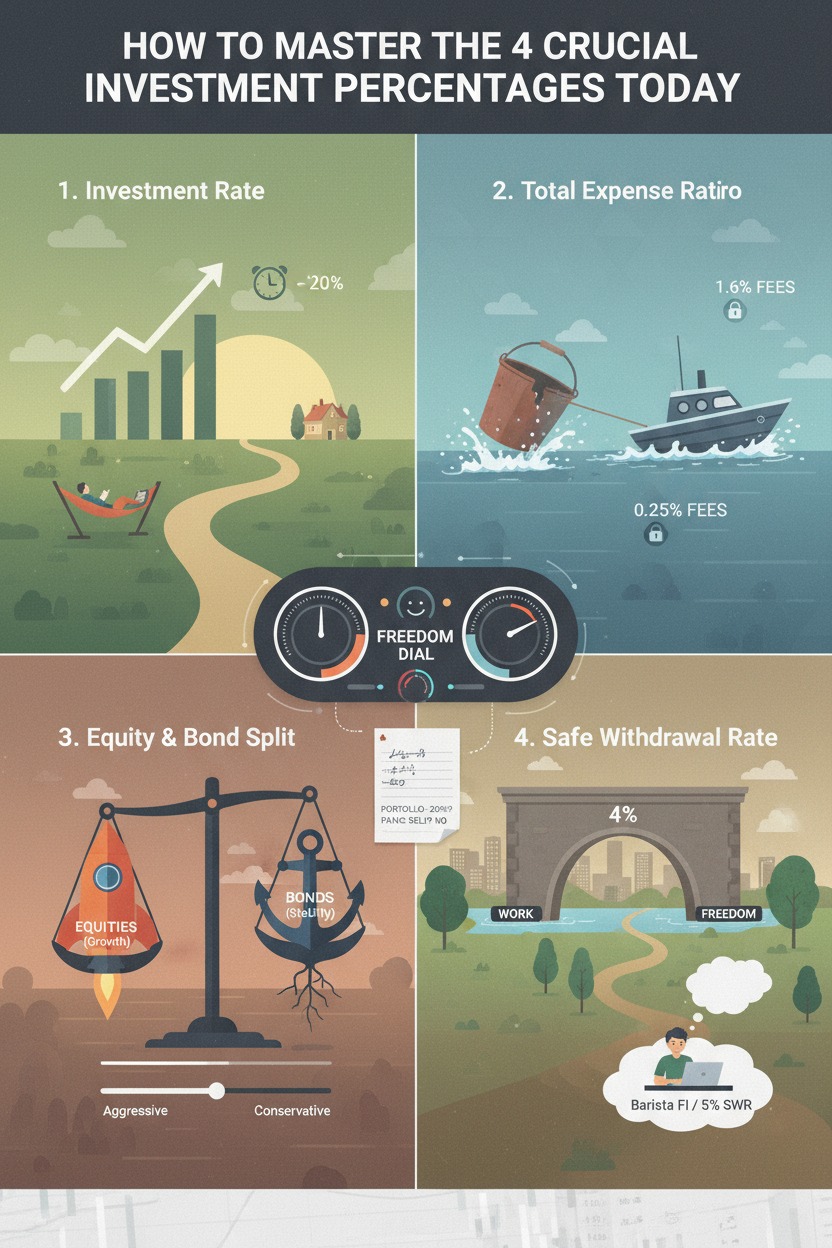
1. The Investment Rate: Your Personal Freedom Dial
If we’re being honest, this is the only number that truly belongs to you. You can’t control what the FTSE 100 does tomorrow (even as it flirts with those 2026 highs), and you certainly can’t control the Bank of England, but you can control the gap between what you earn and what you spend.
Your investment rate is the ultimate speed limit for your journey to freedom. While most people focus on “beating the market” by an extra 1%, they ignore the fact that bumping their investment rate from 10% to 20% does infinitely more for their retirement date than any lucky stock pick ever could.
Think of it as buying future Tuesdays. Every time you increase this percentage, you are essentially pre-paying for a morning five years from now where you don’t have to set an alarm. In the Slow Burn Club, we aren’t about deprivation; we’re about intentionality. Is that extra subscription worth a month of work? Maybe. But knowing the percentage gives you the power to choose.
The Weekend Win: If you’re overwhelmed, start here. This is the biggest hitter. If you can automate a 2% increase this weekend, you’ve effectively shaved months—maybe years—off your mandatory working life.
2. Total Expense Ratio (TER): Stopping the Silent Leak
This is the one that still makes me cringe when I think about my early days. That 1.6% fee felt small at the time—just a tiny sliver, right? Wrong.
Imagine you’re rowing a boat. The market gives you a 7% tailwind. But if your fees are 1% or higher, it’s like someone is dragging a heavy bucket behind the boat. A 1% fee on a 5% real growth rate means you are handing over 20% of your gains to a middleman.
The data in 2026 remains as brutal as it was a decade ago: the vast majority of actively managed funds fail to beat a simple index tracker over the long term. People fall for active management because of “survivorship bias”—we only hear about the one fund that did well last year, not the thousands that tanked. We want to trust a “professional” person because doing it ourselves feels scary.
But the professionals don’t see your costs; they only see their commissions. Switching to a low-cost tracker or a target-date fund with fees under 0.25% is a “set and forget” habit that protects your future self. It’s the ultimate minimalist move.
3. Equity and Bond Split: The Personality of Your Portfolio
This is where you decide how much “growth” you want versus how much “sleep” you want.
- Equities (Stocks): These are the engines. They provide the growth that outpaces inflation.
- Bonds: These are the stabilizers. They provide the gravity.
In my early days, I went straight for the returns—100% equities. It felt brave until the first time the red numbers started blinking. When you’re younger, you can afford to be aggressive because you have the “time asset.” As you move toward the “latter in life” stages, shifting toward bonds is common to protect what you’ve built.
I eventually moved into target-date tracker funds because I realised I didn’t want to think about bonds at all. I wanted the fund to do the “gliding” for me. It’s one less thing to track on my A4 paper.
4. The Safe Withdrawal Rate (SWR): The 4% Anchor
Then we have the famous 4% rule, born from the Trinity Study. It’s the “gold standard” for a reason—it’s a simple, sturdy starting point. But here is where the “spreadsheet warriors” lose their minds. People spend hundreds of hours debating whether 4% is too risky and if 3.25% is “safer.”
The Math of Misery: Have you ever stopped to calculate how many extra years of work it takes to lower your SWR by 0.5%? If that debate pushes your retirement back by three or four years, is it really “safe,” or is it just a different kind of risk—the risk of wasting your youth?
Personally, I’m leaning toward a 5% SWR.
Why? Because I’m thinking creatively. I’m working toward “Barista FI”—the idea that I’ll probably always do something creative or part-time. If the market dips and my 5% withdrawal looks shaky, I’ll just take up an extra job or a freelance project to cover the gap. I’d rather work a few hours a week at something I enjoy than work forty hours a week for an extra five years just to satisfy a spreadsheet.
The “A4 Paper” Stress Test
When I want to do some deep thinking, I get away from the screen. I grab a plain A4 piece of paper and a pen. I write down my current portfolio and my SWR. Then, I ask the big question:
“If my portfolio dropped 20% tomorrow, would I panic-sell?”
This is the ultimate test for your SWR. If the answer is yes, your withdrawal rate isn’t actually safe because your behavior isn’t safe. You don’t need a more complex formula; you need more ballast (bonds) or a more flexible lifestyle (part-time work) to take the pressure off. By brainstorming ideas you can come up with as many creative ways you can survive depending on the scenario that you are currently worrying over.
The Dashboard Life: Keeping it Simple
In the UK, we have the “bridge”—the gap between stopping work and accessing our SIPP or State Pension. This bridge is exactly why we can afford to think differently about the SWR. If you have a pension waiting for you at 57 or 67, your private investments only need to last until then. They don’t have to last forever.
When you see the bridge clearly, the 4% rule starts to look less like a law and more like a helpful suggestion.
How to Master These This Weekend:
- Check your Investment %: Can you find an extra 1%? It’s a habit that pays off forever.
- Audit your Fee %: If you see anything like my old 1.6% “yowzer” fee, move. Switch to a tracker.
- Define your SWR: Pick a number (4% or 5%) and decide how you’ll bridge the gap.
- Embrace the Bridge: Look at your pension as the safety net that allows you to be bolder today.
Gentle Questions for the Road
As the mornings grow a bit crisper and the London fog starts to settle over the parks, I find myself retreating to the kitchen table more often. There’s a certain peace in knowing that while the news is shouting about market “uncertainty,” my little Google Sheet is just ticking along in the background.
Mastering these percentages isn’t about becoming a millionaire overnight; it’s about reducing the “mental load.” When the math is settled on a simple piece of paper, your mind is finally free to wander. You start noticing the small victories—the perfect temperature of your coffee, the book you’ve finally had time to finish, or the fact that you haven’t checked a stock ticker in three weeks.
Questions to take with you:
- If you calculated the “cost” of your spreadsheet obsession in terms of years of life, would you still be happy with the trade?
- What is one “un-financial” activity that brings you more peace than a perfectly balanced portfolio?
- How would your SWR change if you stopped viewing “work” as something you must escape, and started viewing it as something you could do on your own terms?