
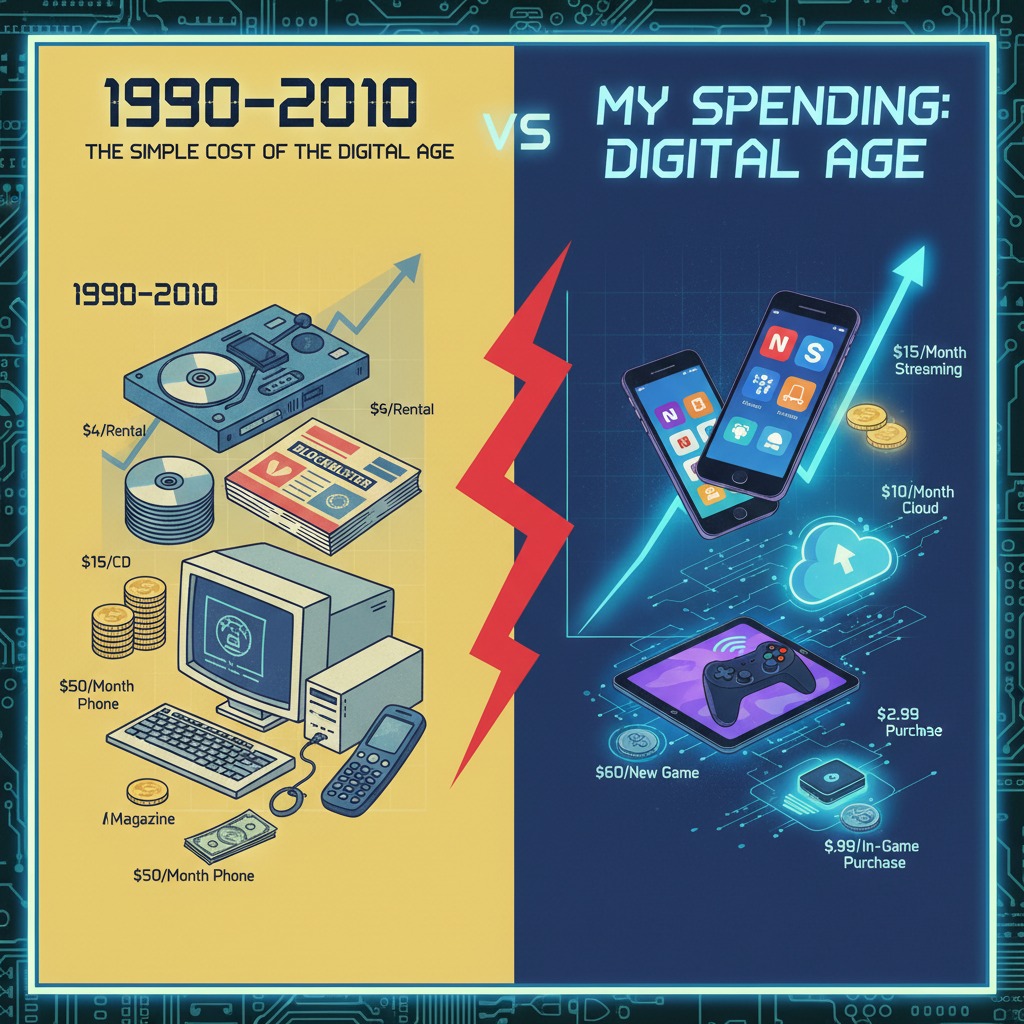
If you are old enough to remember this era, you can probably hear it. Deep in the recesses of your memory, there is the screeching, static-filled, robotic hellscape sound of a dial-up modem trying to connect to the internet.
The three decades spanning 1990 to 2010 represent the most rapid technological shift in human history. We went from waiting ten minutes for a single pixelated image to load (while strictly forbidding anyone in the house from using the landline), to walking around with high-speed broadband permanently glowing in our pockets.
But looking at the ledger for 1990-2010 vs My Spending, something strange happens.
After the wild financial swings of the 60s, 70s, and 80s, the numbers suddenly stop moving. This thirty-year block is the era of the “Great Stabilisation.” It is the exact moment the expensive, modern, digital baseline was locked in.
Here is exactly how the dawn of the internet age compares to my modern pursuit of Financial Independence.
The Great Stabilisation
| Category | 1990 | 2000 | 2010 | My Current Spending |
| Housing | 26.0% | 27.0% | 28.0% | 12.5% |
| Food | 14.0% | 13.0% | 12.0% | 10.0% |
| Transport | 13.0% | 13.0% | 13.0% | 3.0% |
| Clothing | 4.0% | 3.0% | 3.0% | 2.0% |
| Utilities | 14.0% | 12.0% | 12.0% | 8.0% |
| Household Goods | 3.0% | 3.0% | 3.0% | 1.0% |
| Leisure & Recreation | 17.0% | 17.0% | 17.0% | 15.5% |
| Savings / Investments | 4.0% | 5.0% | 6.0% | 39.0% |
| Other | 5.0% | 7.0% | 6.0% | 9.0% |
The £6,700 Phone Trap and the Milestone 2
Looking at the data, you can see how perfectly uniform our spending became. But underneath those flat percentages, the way we bought things completely changed. The tech industry realised that selling us a product once wasn’t enough; they needed us on a permanent upgrade cycle.
I actively refuse to play this game. I have always bought the “second best” or slightly older tech.
My first ever smartphone was a second-hand Motorola Milestone 2, bought two years after its release. It had Google Maps, it functioned perfectly, and crucially, it had a physical slide-out keyboard that I absolutely loved. I am still exactly the same today. I look for simplicity and battery life, not whatever shiny new feature the marketing department insists is “revolutionary.”
People queue up to finance the newest £1,000+ model every single year, completely forgetting that the most basic, entry-level smartphone on the market today possesses vastly more computing power than the machines that sent Apollo 11 to the moon.
The financial difference this mindset makes is staggering.
If I had upgraded to the latest and greatest phone every year over the last decade, I would have easily spent around £7,500. By choosing not to get the best, buying only what I actually need, and running my devices into the ground, I have spent maybe £800 in that same ten-year period.
The biggest tech trap of the modern age is the assumption that you have to upgrade when your phone contract ends. You don’t. The simplest, most effective financial life hack is to keep your perfectly good phone and just switch to a cheap, £10-a-month SIM-only plan for your calls and data.
CDs, Sky Boxes, and the Subscription Illusion
Across these three decades, Leisure and Recreation flatlined at a very healthy 17%. Today, my own leisure budget sits just below that at 15.5%.
But what we are actually buying with that money has fundamentally shifted. Back in the 90s and early 00s, I remember heading to the shops to spend £7 on a physical CD every couple of weeks. When you bought it, you owned it.
Today, we have traded ownership for access.
This era birthed a psychological shift where we slowly agreed to pay endless digital subscriptions just to function in society. On paper, having access to nearly every song ever recorded for a tenner a month seems like a financial win. But here is the ultimate cheat code: I just use the free version of Spotify.
Putting up with a few adverts is a tiny price to pay for keeping my outgoings permanently low. The same logic applies to television; paying for a Netflix subscription is undeniably cheaper than shelling out £50 a month for a massive, clunky Sky Box like we used to. (And let’s be honest, I need my Netflix).
But we have to be careful. It is a different kind of fun now. It is incredibly convenient, but the unfortunate reality of the always-on digital age is that we are far more connected online, and increasingly less connected to actual people in the real world.
The Monthly Payment Illusion (Cars & Chaos)
Look at the Transport line. For three solid decades, the cost of moving around sat immovably at 13%. My transport costs today sit at just 3%.
How did society lock in such a high cost for travel? Because this was the era where car finance and leasing truly took over the mindset of the average consumer.
Honestly, it is amazing to watch. People will buy a car based entirely on what they can afford as a monthly payment. They look at a shiny monthly deal and think it fits perfectly into their budget, completely ignoring the hidden, heavy weights of road tax, insurance, maintenance, and fuel. They have been trained to only look at the monthly number. By avoiding car finance entirely, my transport costs remain an afterthought.
Then there is the chaos.
As Housing crept up to 28% and the financial world over-leveraged itself, this era ultimately culminated in the devastating 2008 financial crash. If I am entirely honest, I barely had any social awareness when it happened. I was a teenager, completely uninterested in global economics, just focusing on having a good time in life.
But looking back with the lens of Financial Independence, I understand it perfectly now.
Savings finally started to register in this era, climbing to 6%. My savings rate today sits at 39%, entirely housed in boring, globally diversified index funds. The lesson of 2008 for an investor is simple: when market chaos happens, it doesn’t mean you panic. It just means you get to buy your index funds on sale.
Beating the Supermarket Layout (And Simple Utilities)
Food costs slowly drifted down during this era, settling at 12%. My modern grocery budget sits at an ultra-lean 10%.
This drop in the 90s and 00s was driven by the absolute peak of the mega-supermarket. But those massive stores are essentially giant psychological traps, designed by experts to make you put things in your trolley that you never intended to buy.
We beat this by applying the exact same simplicity to our food that we do to our tech.
We do things as simply as we can: we use online grocery shopping. By ordering our food through a screen, we completely bypass the in-store advertisements. We don’t fall for the strategic supermarket layouts, and we don’t get tempted by the end-of-aisle promotions. We use the same repeated orders, keep it incredibly simple, and protect our peace (and our wallets).
Even Utilities, which sat at 12% as we began plugging a dozen chargers and routers into our walls, can be managed with basic common sense. My utilities sit at 8%. There is no grand secret to it. I haven’t thought too deeply about it, because I know that simply turning the lights off when you leave a room is still just as effective today as it was thirty years ago.
Gentle Questions for the Road
The dawn of the internet age gave us unimaginable convenience, but it also silently locked us into a highly expensive “baseline” lifestyle. We swapped buying things outright for renting them forever.
Opting out of this system doesn’t mean you have to throw your smartphone in the river and live in the woods. It just means recognizing when convenience has become a trap, and quietly choosing the “second best” option that actually serves you better.
- When your current mobile phone contract ends, could you resist the urge to upgrade and simply switch to a £10-a-month SIM-only plan?
- Take a look at your bank statement: how many digital subscriptions are you paying for that you could actually swap for a free, ad-supported version?
- When you shop for groceries, do you ever fall for the “supermarket layout” trap, and could online ordering keep your ledger a little quieter?