
Looking at my recent Monzo feed is an exercise in casual absurdity.
There is a £7 monthly charge for banking ‘perks’ that buy me a cinema ticket and fee-free cash abroad.
There is an £8.99 deduction for invisible audiobooks, mostly because reading physical pages puts me straight to sleep.
Trying to explain this to a bank clerk from the year 1900 would be a spectacular failure.
Explaining inflation would be hard enough.
Explaining that I pay a bank for the privilege of watching moving pictures and listening to a disembodied voice read to me? They would assume I had lost my mind.
It makes you wonder about the baseline of our daily existence.
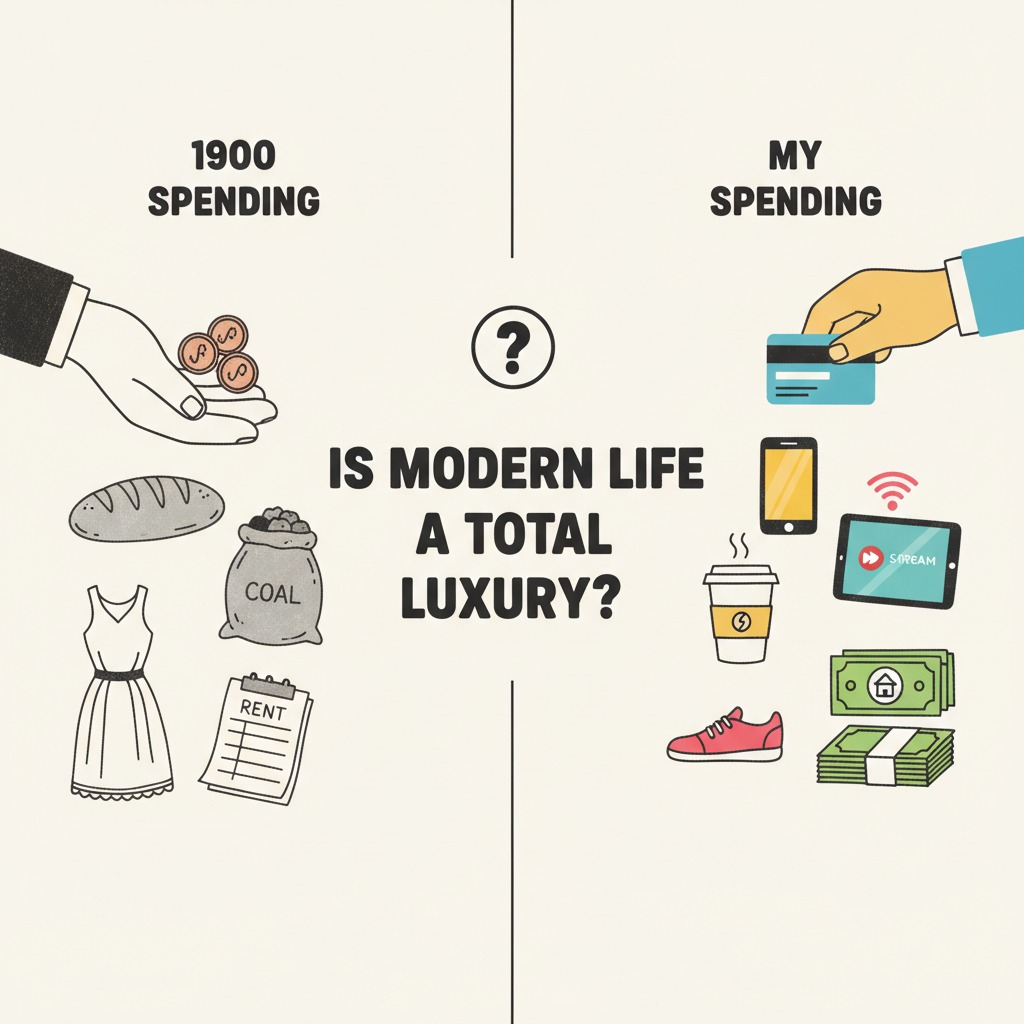
Looking closely at 1900 spending vs my spending: is modern life a total luxury? Are we drowning in convenience, or are we just allocating our resources to survive a completely different kind of world?
Let’s look at the numbers.
The Time-Travelling Ledger
To make a fair comparison across a century of inflation and societal shifts, we have to look at percentages.
Pound-for-pound comparisons fall apart when a loaf of bread cost a penny, but a coat cost a month’s wages.
Here is how a working-to-middle-class budget in the Edwardian era stacks up against modern life.
The Century Spread: Where the Money Goes
| Spending Category | The 1900-1909 Brit (Working/Middle Class) | The Modern Average Brit (2024 ONS Data) | My Modern Budget (Approx. Percentages) |
| Housing & Heat (Rent/Mortgage, Utilities, Maintenance) | 15 – 20% (Drafty renting & heavy coal use) | ~35% (High rents/mortgages & the modern grid) | ~25% (£280 mortgage + £150 bills + £120 sinking fund) |
| Food & Drink (Groceries & Dining Out) | 50 – 60% (Almost entirely raw ingredients, high effort) | ~16% (Split between groceries and convenience) | ~18% (£200 home food + £200 eating out) |
| Clothing | ~15% (Clothes were an investment, repaired often) | ~5% (The fast fashion era) | ~2% (£50 budget – mostly charity shops & quality items) |
| Leisure & Holidays (Entertainment, Travel, Subs) | < 5% (Highly localised, occasional music halls) | ~15% (Subscriptions, tech, holidays) | ~20% (£225 holiday + £200 entertainment) |
| Future Freedom (Investing, Pensions, Savings) | ~0 – 5% (Children were the retirement plan) | ~10% (Pensions/standard savings) | ~24% (£500 investing + £25 child investments) |
| Admin & Childcare (Union, Insurance, Nursery, Phones) | < 2% (Basic union fees, maybe a burial club) | ~19% (Childcare, insurance, transport, tech) | ~11% (£150 nursery, £21.74 EE, £17.70 Union, £15.86 Insurance) |
Looking at these figures, the most staggering shift is right there in the food category.
In 1900, people spent over half their waking hours and income just trying not to starve.
Today, I spend around 18% of my budget on food, and half of that (£200) is dedicated to eating out.
It brings me a lot of happiness to sit around a table with my family, enjoying a meal someone else cooked.
It is a luxury, absolutely.
But I am also deeply aware that modern technology and supply chains are the only reasons we aren’t spending 60% of our wages on basic flour and potatoes.
Knowing this historical fact entirely shifts how I feel walking down the aisles of a supermarket.
We have so much more room to breathe.
Housing Superpowers & The Edwardian Wardrobe
My mortgage is currently £280 a month.
In the modern UK landscape, that is nothing short of a financial superpower.
It sits right around 12.5% of my income, which ironically is exactly what an Edwardian family might have paid in rent.
The difference, of course, is equity.
They paid for drafty walls and zero ownership; I am paying down an asset.
I also keep a £120 sinking fund for service charges, painting, and DIY.
It is the slow, unsexy reality of homeownership, but it beats hauling coal upstairs every morning.
Once this mortgage is cleared, my housing costs will drop to just bills and that maintenance fund.
Picturing that day—having zero core housing debt—feels like unlocking a level of freedom a 1900s renter couldn’t even fathom.
Then there is the clothing budget.
I allocate about £50 a month for clothes, which accounts for a tiny 2% of my spending.
In this specific area, my habits are much closer to a 1900s mindset than a 2026 one.
I have zero interest in the modern fast-fashion cycle.
Walking past high-street stores with their constantly rotating mannequins actually gives me a quiet sense of rebellion.
- I prefer high-quality items that are built to last.
- I genuinely enjoy the hunt of a good charity shop find.
- I would rather spend more upfront for something durable than replace cheap fabric every season.
It turns out that ignoring fast fashion is one of the easiest ways to embrace minimalism.
It keeps the budget incredibly lean, and it keeps the wardrobe deeply intentional.
1900 Spending vs My Spending: The Cost of Not Waiting Until 68
If you want to know what someone truly values, look at their leisure and their savings.
My leisure and holiday budget is noticeably higher than the historical average, and even the modern average.
I spend £225 a month toward holidays and £200 on entertainment.
This funds 3 to 5 smaller trips a year, with one larger trip every three or four years.
Whether it is chasing the sun abroad or exploring closer to home, these are the experiences that make the daily grind worthwhile.
I can afford this because I keep my fixed costs—like clothes and housing—so low.
But the biggest swing on the entire ledger is the £525 going toward ‘Future Freedom’.
That breaks down to £500 in my own investments, and £25 into a children’s investment account.
In 1900, the concept of early retirement simply did not exist.
You worked until your body gave out, and your children were your pension plan.
Today, the state tells us we can rest when we are 68.
I have absolutely no intention of waiting that long.
I want to be out in the world, travelling and experiencing life, while I still have the physical energy to do so.
That £500 a month isn’t just numbers on a screen; it is a time machine.
It is systematically buying back the years that previous generations were forced to spend on a factory floor.
Interestingly, not everything in my budget is purely modern.
I still pay £17.70 a month for my Union membership.
It is a direct throwback to the early 1900s, an old-world layer of protection that still holds immense value today.
Some things don’t need disrupting.
Finding Simplicity When Modern Life is a Total Luxury
We often romanticise the past as a simpler time.
But ‘simple’ in 1900 usually meant backbreaking labour, constant mending, and spending everything you earned just to stay warm and fed.
My £150 gas and electric bill is a modern miracle compared to an open hearth.
My £21.74 EE phone bill connects me to the entire globe.
So, when comparing 1900 spending vs my spending, is modern life a total luxury? Yes. Unequivocally.
But that doesn’t mean we have to participate in the exhausting parts of modern consumerism.
Financial Independence and Minimalism aren’t about living like a Victorian monk.
They are about selectively choosing which modern luxuries actually serve you.
I will gladly pay £8.99 for audiobooks because they fit my brain.
I will happily pay nursery fees so my child thrives, rather than sending them to work in a mill.
The secret to this whole Slow Burn approach is brutally simple.
Keep the boring stuff cheap, ignore the high-street noise, and pour your resources into buying back your time.
You don’t need a time machine to find a simpler life.
You just need to be incredibly picky about what you allow on your bank statement.
Gentle Questions for the Road
As the year subtly shifts and the light begins to change, I often find myself reassessing what feels ‘necessary’ in my day-to-day life. Looking at a century-old ledger is a jarring reminder that necessity is entirely subjective. What was once a fight for basic calories is now a decision between cooking at home or enjoying the luxury of a restaurant table with the people I love.
It makes me deeply grateful for the quiet, unremarkable conveniences we completely ignore. Turning on a tap, flipping a light switch, or having a small plastic card that grants us a free coffee and a cinema ticket. Realising how much easier the mechanics of living have become frees up so much mental space to actually live.
- When you look at your own spending, which ‘modern luxury’ brings you the deepest sense of genuine joy or relief?
- If you could strip away one modern expense that feels more like a burden than a benefit, what would it be?
- How are you using your current resources to buy back your energy and time for the years ahead?