
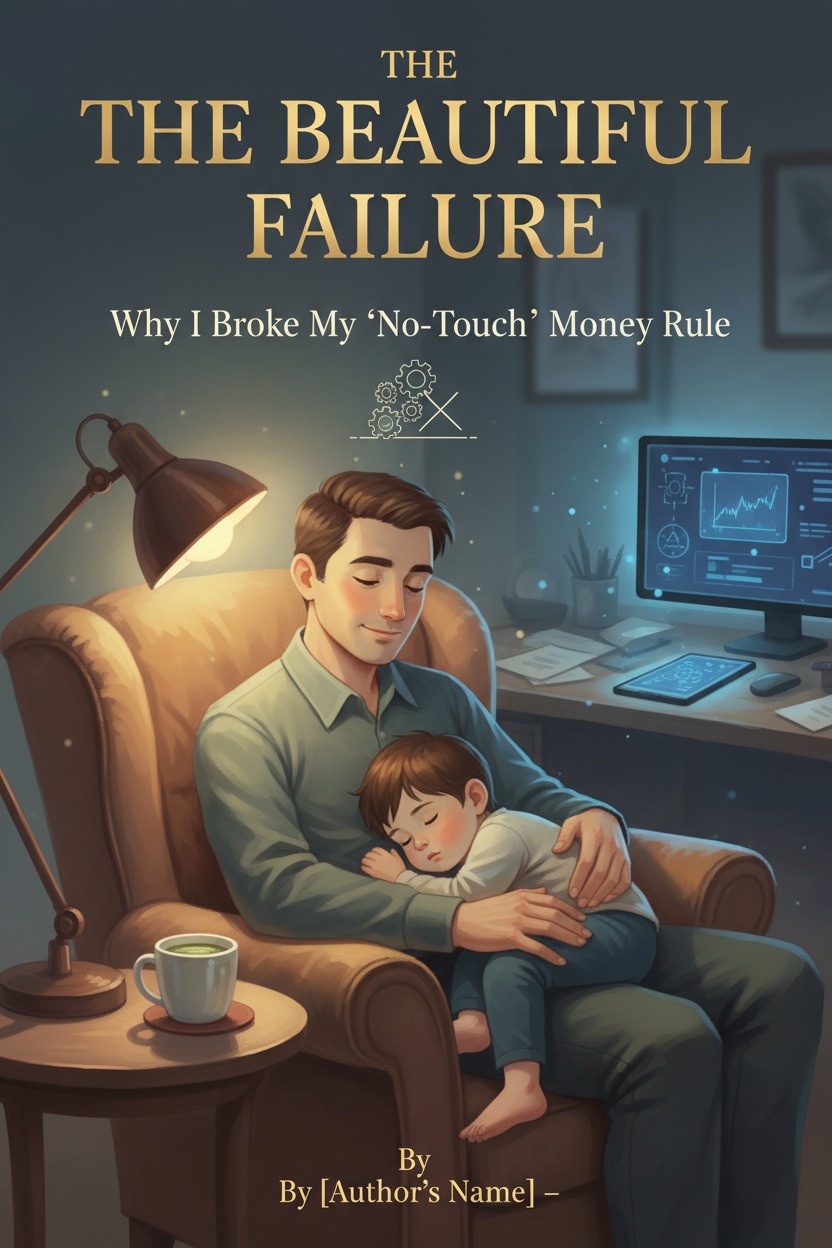
I was supposed to be a monk. A financial, spreadsheet-wielding monk who had reached a state of “set and forget” nirvana.
Back in December, I made a public vow: no changes to my financial system until April. I called it my “no-touch” plan. The goal was to stop the constant tweaking, the obsessive mortgage overpayments, and the mental gymnastics of trying to shave pennies from one bucket to fill another.
I lasted until February.
On paper, this is a failure. I broke my own rule. I touched the untouchable. But as I sit here with a very specific, very delicious vanilla matcha buzz, I’ve never felt more successful.
Sometimes, the “perfect” plan is actually just a sophisticated way of torturing yourself.
The 2 AM AI Spiral
The breaking point didn’t happen in a bank branch or during a sensible meeting with a financial advisor. It happened in the blue light of my smartphone at 2:14 AM.
I was lying in bed, running simulations. Not just mental maths, but full-blown AI-driven scenarios. I was asking Claude and ChatGPT to stress-test my “wiggle room.”
“If I keep £200 in the mortgage overpayment pot but the interest rates shift by 0.5%, what is the opportunity cost compared to a global index fund over 18 years?”
It was a spiral. I was tired, my eyes were stinging, and I was desperately trying to “optimise” a future that hasn’t happened yet.
Then, at 3:00 AM, the simulation was interrupted by a much more urgent reality. My little one woke up, tugged on my arm, and asked for a story.
Standing there in the hallway, shattered, trying to remember the plot of a book about a hungry caterpillar while my brain was still calculating compound interest, something snapped.
The “wiggle room” wasn’t giving me flexibility. It was giving me a headache.
The Curse of the Wiggle Room
For most people, having £200 of “unallocated” money is a dream. It’s a safety net. It’s spontaneity.
But for a recovering overachiever at the £10–50k stage of Financial Independence, that £200 was a playground for anxiety. It was “loose” money, and loose money needs a home.
Because it wasn’t strictly assigned, I was constantly debating its fate:
- The Mortgage: It’s not mathematically “sound” compared to investing, but the emotional pull of being debt-free is like a Siren song.
- The Emergency Fund: It’s already full. Adding more felt like hoarding, but hoarding feels like safety.
- The Timing Trap: “Maybe I’ll just wait for a market dip?” I knew it wasn’t “time in the market,” but the wiggle room allowed me to pretend I could time it.
The wait until April had no purpose other than testing my willpower. It was dogma for the sake of dogma. By refusing to make a decision until an arbitrary date, I was forcing myself to make that decision every single night in my head.
Tightening the Bolts: The New “Extreme” System
I decided to stop sitting on my hands and start using them to bolt the system shut.
I didn’t just make a “tweak.” I removed the ability to tinker entirely. I tightened the flow until there was no residual “waste” left in the pipes.
Here is what the “failure” looks like in numbers:
| Category | Old Plan | New “Extreme” Plan |
| Monthly Investing | £250 | £400 |
| School Fund | £0 | £50 |
| Wiggle Room | £200 | £0 |
| Manual Transactions | Multiple | 1 (The “Joy Fund” sweep) |
I upped the investing to £400 because I know, logically, that is where the growth happens. I carved out £50 for the little one’s future school fund because it aligns with my values now, not in April.
The most radical change? If there is any money left over at the end of the month—even if it’s just £25—it gets shoved into a “Joy Fund.” It’s for big, fun, slightly irresponsible purchases. No simulations allowed.
Why “Zero” is the New Peace
There is a specific kind of minimalist satisfaction in seeing a bank balance hit £0 (outside of my living expenses).
In my world, unallocated money is “waste.” It’s energy that hasn’t been directed. By removing the wiggle room, I’ve removed the “What if?” factor. The decisions are made. The automation is locked.
The headache is gone.
Living on £480 and Vanilla Matcha
People often think that a “tight” financial system feels like a straitjacket. They imagine me counting out grains of rice or shivering in the dark to save on the heating bill.
The reality is much more caffeinated.
I have roughly £480 available for “living.” That covers the brunch, socialising, clothes and my current obsession: vanilla matcha powder.
I’ve discovered that a high-quality matcha gives me a sustained, focused buzz that coffee never could. It’s a small, daily luxury that makes the system feel expansive rather than restrictive.
Because the £400 is already invested and the £50 is already in the school fund, I can spend that £480 with zero guilt. I’m not “taking away” from my future when I buy a nice tin of matcha, because the future has already been paid.
The Partner Factor: “Why Not £500?”
When I showed the new, tightened system to my partner, I expected a pat on the back for my newfound discipline.
Instead, I got the classic supportive side-eye.
“I thought you could probably do £500, not £450,” they said.
It’s the kind of comment that only someone who truly believes in you can make. It wasn’t a criticism; it was a reminder that I’m capable of more than I think. But for now, I’m sticking with my “failure.”
I’m happy. I’m better off than 95% of the population because I actually have a system that works while I sleep. And more importantly, I’m actually sleeping now.
No more 2 AM simulations. No more arguing with AI about interest rates. Just a quiet, efficient machine humming in the background while I focus on things that actually matter—like my health, my writing, and being awake enough to tell a decent 3 AM story.
Gentle Questions for the Road
We spend so much time trying to be the “perfect” version of ourselves—the version that never breaks a rule and always stays disciplined. But sometimes, the most disciplined thing you can do is admit that your current rules are making you miserable.
Efficiency isn’t just about the numbers on a screen; it’s about the residual energy you have left for your life. If your financial plan requires you to spend three hours a night “optimising” it, it’s not a plan—it’s a part-time job you didn’t apply for.
As we move through this season, I’m learning to embrace the “beautiful failure.” I’m learning that a system that is 100% automated and 98% “perfect” is infinitely better than a 100% perfect plan that keeps me awake at night.
Questions to take with you:
- Where in your life are you holding onto a “rule” that no longer serves a practical purpose?
- Does your “wiggle room” give you freedom, or does it give you an excuse to over-analyse?
- If you tightened your system to the point where there was “nothing left to do,” what would you do with that extra mental space?