
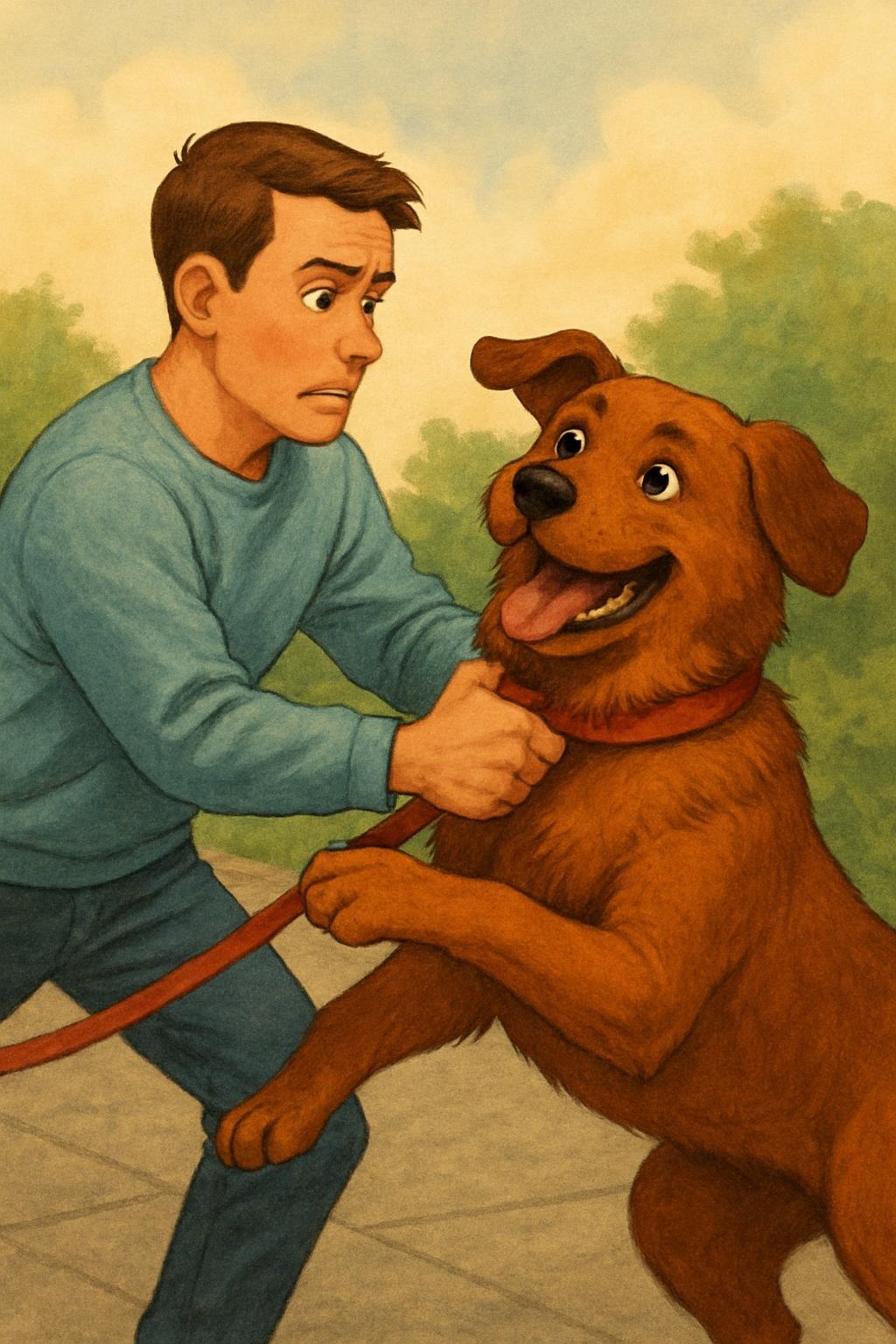
It was an ordinary moment. Coffee in hand. Pavement familiar. One of those small pockets of calm that sit between errands and the rest of the day.
Then a dog appeared from behind me.
Not charging. Not barking. Just suddenly there, nose level with my little one, curious and uninvited. The scream came first — sharp, panicked, full-body fear. My partner’s hands were full of coffee. There was no time to assess. No time to negotiate. No time to do anything clever.
My arms moved before my brain did.
I reached back, grabbed scruff and collar, and pulled.
When the Body Decides for You
The adrenaline hit instantly. Heat, focus, narrowing. All I could see was my little one. The rest of the world — pavement, passers-by, the coffee — disappeared.
There was no sentence in my head. No internal monologue. Just a single, blunt word:
No.
Not this. Not now. Not them.
Later, people talk about fight or flight as if it’s a choice. In that moment, it wasn’t. My body had already decided. I didn’t feel brave. I didn’t feel strong. I felt automatic.
And that, somehow, was enough.
The Longest Two Minutes
While I held the dog away, the thoughts arrived late and all at once.
What if it bites my baby?
What if it bites me?
What if grabbing it makes everything worse?
What if this goes wrong in a way you can’t undo?
Those thoughts didn’t stop my arms. They just piled up behind the action, waiting their turn.
It took a good two or three minutes after the dog was clearly away for my nervous system to stand down. My hands shook. My chest buzzed. That strange after-feeling when you realise how close “fine” and “disaster” can sit next to each other.
This could have gone very differently.
Plot Twist: The Friendliest Dog Alive
And then — the absurdity.
Once the dog was away from my little one, it immediately leaned against my leg. Properly leaned. Heavy, affectionate, insistent. If I stopped petting it, it bumped my hand until I resumed.
Reader, this dog just wanted attention.
She was called Sybil. She was friendly. Oblivious. Entirely uninterested in causing harm. The contrast was almost comic: moments earlier, pure panic; now, a dog demanding scratches like we were old mates.
The story flipped instantly. My body did not.
Fear doesn’t apologise just because it turns out everything’s fine.
“I’d Take the Bite”
There was a thought that landed later, quieter but heavier.
If it had bitten someone, I would have wanted it to be me.
That’s an obvious thing to say. People say it all the time about their children. But knowing something intellectually and feeling it are very different experiences. Until that moment, I don’t think I understood the depth of it.
It wasn’t heroic. It wasn’t dramatic. It was matter-of-fact. Almost boring in its certainty.
This is what gets protected. Everything else is negotiable.
Are We Only Using 20% of Ourselves?
What lingered most wasn’t the fear. It was the capacity.
How much showed up without warning. How much clarity arrived under pressure. How much was available when there was no time to overthink.
It made me wonder if, most of the time, we’re operating at a fraction of what we’re capable of. Not because we’re lazy or weak — but because life doesn’t usually require more.
There’s something a little sad in that realisation.
But also something reassuring.
We couldn’t live at that level all the time. It would burn us out completely. That version of us is for emergencies, not emails. For crunch moments, not daily admin.
Still, it’s good to know it’s there.
A Pattern of Not Overthinking
Looking back, the best things I’ve done in my life came from the same place — quick decisions, trusted impulses, very little optimisation.
Working in America for two summers. Best job I ever had.
Saying yes to having a little one. No spreadsheet could’ve prepared me.
Walking into a job interview without overthinking it — and nailing it.
Going to Japan for three-and-a-bit weeks with an eight-month-old. Wild. Wonderful. Completely impractical.
In each case, I trusted the first instinct and moved before fear could organise itself into a convincing argument.
Two Selves, One Life
I know both of these people live inside me.
There’s the careful planner — the one who builds guardrails, thinks ahead, keeps things ticking along. That version is essential for daily life.
And then there’s the one who acts when there’s no time to think. The one who handles situations that need handling.
Neither is better. Neither is wrong.
Problems start when we only listen to the planner, and never let the other one out for air.
Walking a Little Taller
I didn’t come away from this feeling like a superhero. If anything, the experience was humbling.
But I do walk a little taller now.
Not because I want more scary moments — absolutely not — but because I trust myself more. I know that when something genuinely matters, I won’t disappear into overthinking. I’ll show up.
Also, for balance: I am not the world’s best parent. I once made my little one cry by putting cold toast in the bin. Let’s keep perspective.
Gentle Questions for the Road
Moments like this don’t announce themselves in advance. They arrive mid-coffee, mid-walk, mid-life. And often, they reveal more about us than years of careful planning ever could.
We don’t need to seek out fear to learn from it. But when it shows up, it can quietly recalibrate how we see ourselves — not as fragile, but as capable in ways we rarely test.
Questions to sit with:
- When was the last time you surprised yourself under pressure?
- Where might overthinking be holding you back from something you could handle?
- Which version of you manages daily life — and which one steps in when it really matters?
- What would trusting your first instinct look like, just once?