
Ah, that changes the “why” in a really interesting way! It wasn’t just a loss of transport; it was a total collapse of your physical boundaries. Going from a 15k-step commute to a “bed-to-desk” commute is the ultimate sedentary trap.
I’ve adjusted the narrative to reflect the work-from-home reality and expanded the word count to hit that 1300+ mark.
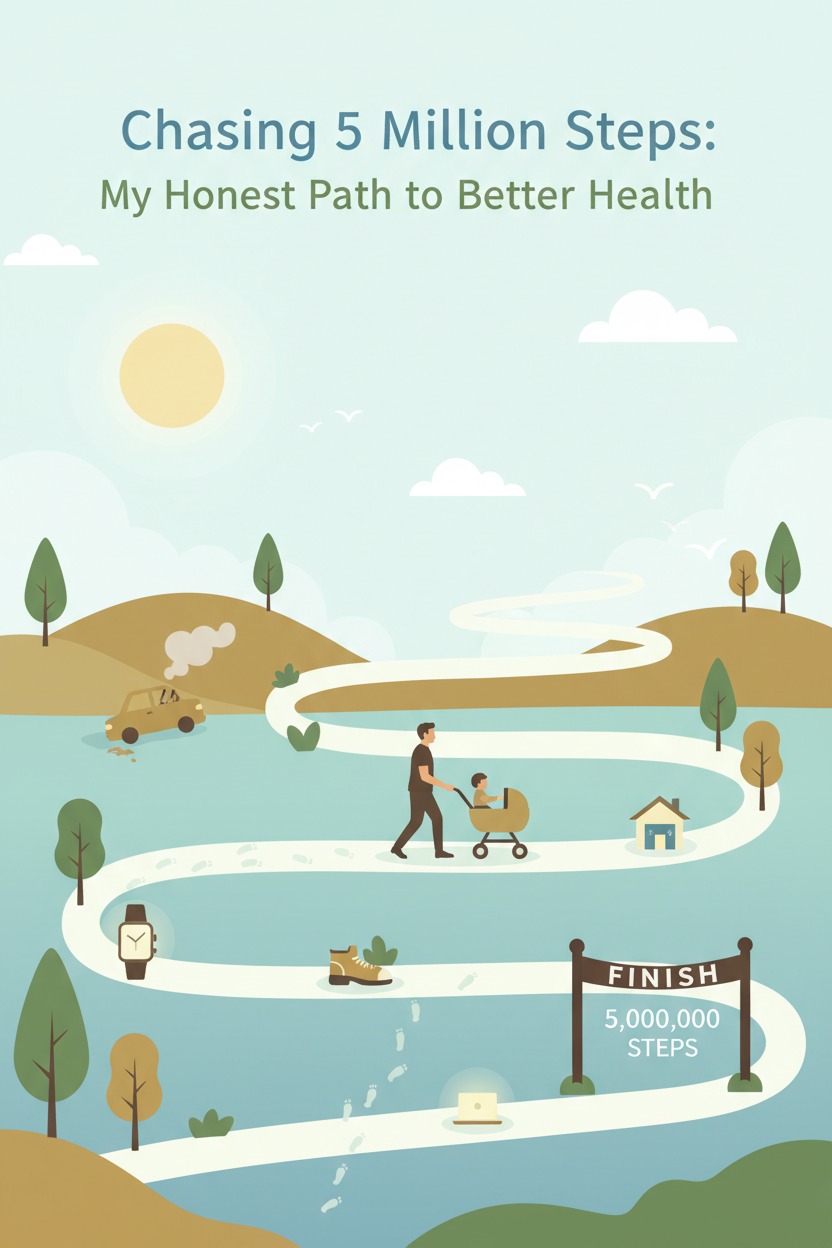
Chasing 5 Million Steps: My Honest Path to Better Health
There is a particular kind of silence that follows the death of a car. It’s not the peaceful, rolling-hills kind of silence; it’s the expensive, “why-is-there-smoke-coming-from-the-bonnet” kind. When my old motor finally gave up the ghost years ago, the repair bill was a punchline to a joke I wasn’t in the mood to hear. The cost to fix it was officially more than the car was worth.
I didn’t replace it. Instead, I became a walker by necessity.
Back then, my life had a built-in system. My commute transformed into a reliable, twice-daily trek that banked me 15,000 steps without me having to exert a single ounce of willpower. I didn’t need “motivation”; I just needed to get to my desk. Over the space of a year, that accidental system melted 20kg off my frame. My clothes fitted better, my energy levels peaked, and for the first time since university, I felt like I was winning at the health game without even trying.
But then, the world shifted. I moved into a different role—a work-from-home situation. Suddenly, the 15,000-step safety net vanished. My “commute” became the distance from my bed to my laptop, a grand total of about twelve paces if I took the long way via the kettle.
I’ve realised that without a forced system, I am remarkably good at sitting still. The weight I’d worked so hard to shed started to creep back like an unwanted houseguest who refuses to read the room. That is why I’m here, publicly committing to something that feels a little bit ridiculous: 5 million steps in a single year.
The “Just a Bit Extreme” Metric
Why 5 million?
If I wanted to play it safe, I’d aim for 3 million. Three million steps is roughly 8,000 steps a day—a sensible, respectable number that most health apps would give you a gold star for. But for a recovering overachiever, 3 million feels like maintenance. It feels like “getting by.”
I wanted something that required a little more grit.
Five million steps is a 60% increase on “sensible.” It’s a number that demands I change my life, not just my shoes. It’s an average of about 13,700 steps every single day for 365 days straight. In a work-from-home world, that many steps don’t just “happen.” You have to hunt them down.
There’s a healthy dose of fear in saying this out loud. Publicly announcing a goal like this on a platform like the Slow Burn Club feels like standing in the middle of a village square and shouting, “I’m going to try really hard not to fail!” It’s uncomfortable. But that discomfort is the point. I’ve reached that post-university stage where “I’ll get around to it” has become a permanent state of being. By putting this goal in writing, I’m burning the metaphorical ships.
January: A Comedy of Errors and Freezing Winds
If I were a character in a film, the montage of my January progress would not be set to inspiring orchestral music. It would be set to the sound of a cold, whistling wind and the rhythmic squelch of a boot sinking into a puddle.
I finished January with 327,580 steps.
On paper, that’s 6.55% of the way to the 5-million mark. If I were perfectly on track, I should be at 8.33%. I am, effectively, starting the year with a deficit.
I’d like to blame the British weather, and I will. January in the UK is a special kind of miserable. It’s not just the cold; it’s the grey, damp heaviness that makes the sofa look like a lifeboat and the front door look like a portal to another dimension. There were days when the freezing winds were so sharp I felt like I was being exfoliated by a belt-sander.
Then there was the “Great Jacket Betrayal.”
I’ve known since last April that my rain jacket had a few small holes under the armpits. I told myself they were “ventilation.” By mid-January, those small holes had evolved. They were no longer vents; they were hand-span tears. There is a very specific kind of misery that comes from walking into a headwind and feeling icy rainwater funnel directly into your armpit. It’s a quick way to turn a “reflective stroll” into a “sprint for survival.” My gear wasn’t up to the task, and frankly, some days, neither was my resolve.
The Great Watch Scavenger Hunt
Before I could even start tracking my progress (or my lack thereof), I had to find my tools. I used to wear a tracking watch religiously during my “15k a day” era, but I took it off when my little one was born. I was terrified of scratching a newborn with the strap or the metal bezel during those middle-of-the-night feeds.
The watch was relegated to “a box.” Specifically, one of three mystery boxes that moved house with us and had remained stubbornly sealed.
Finding that watch turned into an accidental exercise in minimalism. I had to dig through layers of old cables, half-empty notebooks, and the general detritus of a life lived in a hurry. By the time I found the watch, I’d inadvertently decluttered a quarter of the spare room.
Putting it back on felt heavy. It wasn’t just a piece of tech; it was a reminder of the version of me that used to hit my goals without blinking. Now, I have a toddler who is absolutely obsessed with the thing. Every time the screen lights up with a notification or a step count, I have a tiny person grabbing at my wrist, demanding to see the “sparkly numbers.”
Resistance Training (The Toddler Factor)
The “Slow Burn” approach to health is often about working with what you have. Right now, what I have is a very active, very heavy toddler.
In my old life, 10,000 steps was just a walk. Now, 10,000 steps often involves pushing a buggy through a January “mud-fest.” It’s a glute workout that would make a CrossFit instructor weep. There have been days where the local route to the windmill—my usual go-to for peace and quiet—has been so bogged down that I’ve had to retreat to the pavements.
Pushing a buggy against a headwind while your rain jacket is flapping open at the seams is peak “parent-fitness.” Sometimes, the toddler decides they’ve had enough of the buggy and want to be carried. That’s when the “slow burn” becomes a “high-intensity burn.” Carrying a “heavy lump” of a child for the last mile of a walk is the kind of functional strength training no gym can replicate. My glutes are certainly feeling the 5-million-step goal, even if my spreadsheet says I’m behind.
The Math of the “Make-Up” Phase
So, where does that leave me?
To hit 5 million by December 31st, I have 4,672,420 steps left to go. Over the remaining days of the year, that averages out to approximately 13,989 steps per day.
Is it doable? Yes. Is it going to be easy? Absolutely not.
In a work-from-home environment, 14,000 steps requires a level of intentionality that I haven’t had to exercise in years. It means “fake commutes” in the morning, pacing during Zoom calls, and embracing the evening stroll even when the sun has long since vanished.
The “Slow Burn” philosophy isn’t about panicking because I’m 1.7% behind my January target. It’s about recognizing that seasons change. January was for surviving. January was for finding the watch and realizing I need a new jacket. It was about acknowledging that the “easy” days of accidental fitness are over, and the era of systemic change has begun.
As the days get lighter and the “mud-fest” dries into actual solid ground, those 14,000 steps will come easier. I’m moving away from the “accidental” fitness of my old car-less life and into a phase of deliberate growth. I’m not just trying to lose weight; I’m trying to prove to myself that I can stick to a long-term ambition even when the work-from-home trap tries to keep me tethered to my chair.
Gentle Questions for the Road
There is something humbling about being a beginner again. It’s easy to look back at the “15k-steps-a-day” version of myself with a bit of envy, but that person didn’t have to fight for those steps. They were a gift of circumstance. This time, every step is earned. Every mile clocked is a tiny victory over the sedentary trap of the modern workday and the siren call of the biscuit tin.
As we move into the slightly-less-grey days of February, I’m focusing on the feeling of my clothes fitting just a little bit better and the quiet satisfaction of the watch buzzing on my wrist. It’s a long road to 5 million, but the best thing about a walking goal is that you can only take it one step at a time.
Reflections from the Mud: The transition from “forced movement” to “chosen movement” is one of the hardest shifts to make. When the car died, I didn’t have a choice. Now that I work from home, the choice is entirely mine—and that’s where the real work happens. It’s easy to be healthy when life forces you to be; it’s much harder when life invites you to be comfortable.
Questions for the Road:
- What “automatic” healthy habit did you used to have that has since slipped away due to a change in your work or home life?
- Is there a “broken rain jacket” in your life—a tool or a piece of gear you’ve been ignoring that is actually making your goals harder to reach?
- If you were to pick a “just a bit extreme” goal for the year, what would it look like for you?
- How can you recreate a “system” for movement when your environment (like working from home) encourages you to stay still?