
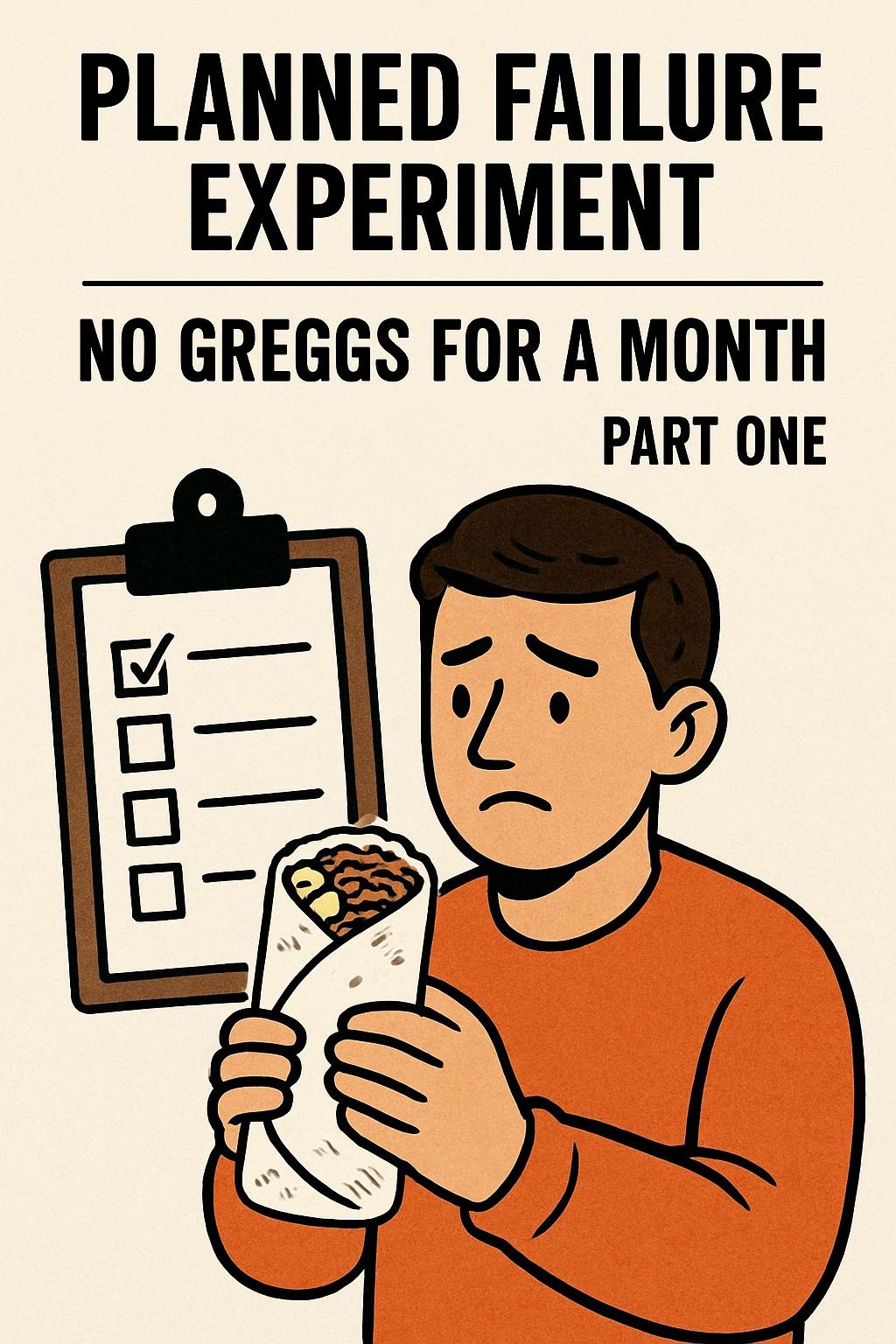
This is not a redemption arc.
It’s not a “new me” announcement.
And it’s definitely not a wellness glow-up disguised as a spreadsheet.
This is Part One of a planned failure.
I’m running an experiment where I don’t eat Greggs for a month. No sausage rolls. No “just this once.” No standing at the counter pretending I’m only here for a coffee.
Instead, I’m eating homemade burritos.
Not because they’re trendy. Not because they’re optimised. But because this whole thing sits inside my Planning to Fail lab — the place where I stop trying to be sensible and start trying to be intentional.
This is the setup. The rules. The friction. The first week of data.
No neat ending yet. I’m still in it.
Why I’m Doing This: Planned Failure, Not Willpower
Planning to fail sounds counterintuitive, but it’s been quietly changing how I approach everything.
When you assume you’re going to fail:
- You stop pretending discipline will save you
- You stop relying on motivation
- You design systems that expect mess, hunger, boredom, and bad days
Failure stops being personal. It becomes information.
This experiment isn’t about proving I’m “good” or “consistent.” It’s about asking a more interesting question:
What happens when I expect myself to fail — and plan for it anyway?
“No Greggs for a month” is the headline.
But the real experiment is how much friction I’m willing to add to my own life to make a habit change stick.
Because avoiding something is easy.
Replacing it properly is harder.
So I chose harder.
Failing Hard on Purpose: The Burrito Plan
Let’s be clear:
Not eating Greggs is basic.
The real challenge is what I replaced it with.
I didn’t pick a protein bar.
I didn’t pick a sad apple and a sense of moral superiority.
I picked burritos. Proper ones.
But I stacked the difficulty on purpose.
If I want to succeed at this experiment, I have to:
- Buy the ingredients
- Make the burritos myself
- Make double the amount (because my partner eats them too)
- Wrap them
- Freeze them
- Remember to take them to work
- Microwave them
- Eat them while walking past Greggs
That is objectively harder than walking into Greggs and pointing at the thing behind the glass.
That’s the point.
This is failing hard:
- More effort
- More steps
- More chances to mess it up
The burritos aren’t a downgrade. They’re actually great. Eggs, beans, onions — warm, filling, borderline gourmet by weekday standards.
They’re also pocket-sized, which means I now walk past Greggs holding what are essentially edible hand warmers.
Is this ridiculous? Yes.
Is it effective? So far, also yes.
Week One: Tracking, Friction, and Small Wins
I’m tracking this the simplest way possible: a paper sheet.
Each day gets a quiet yes or no for junk food.
No apps. No streaks. No drama.
Week One Results (So Far)
- No Greggs
- Only burritos
- No “accidental” detours
- Experiment technically working
But here’s the more interesting part.
Today is Friday.
I’ve had two burritos already.
I am overly full. Not satisfied-full. Just… stuffed.
It doesn’t feel great.
That’s not a failure. That’s data.
It tells me:
- Portion size matters
- Hunger cues are still learning
- Convenience doesn’t automatically mean balance
It also tells me I need to:
- Buy more wraps
- Batch cook again today
- Adjust before Monday
This is what iteration looks like when you’re not pretending to be perfect.
The Money Bit (Without the Trumpets)
Let’s talk numbers, briefly and honestly.
- Greggs would have been: £3 × 5 days = £15
- Burritos cost me about: £6
- Money saved this week: £9
Nice? Yes.
Life-changing? No.
And that’s important.
This experiment isn’t secretly about becoming rich through burritos. It’s about noticing how much effort we’ll put in — or avoid — for relatively small returns.
Sometimes the lesson isn’t “save more.”
It’s “be honest about why you’re doing this.”
Where This Is Headed (And Why I’m Not Wrapping It Up)
This is Part One.
The experiment is still running.
I expect:
- Boredom
- Laziness
- At least one moment where Greggs feels inevitable
If I fail, I fail having already:
- Broken a habit for a week
- Saved some money
- Learned what friction actually feels like
That’s not nothing.
I’ll be updating this weekly.
No victory lap yet. No moral of the story.
Just data, burritos, and whatever happens next.
Gentle Questions for the Road
There’s something quietly revealing about making your life harder on purpose — not as punishment, but as design.
When convenience is removed, habits suddenly look less inevitable and more… optional. Not easy to change. But visible.
And visibility is usually where things start to shift.
Questions to sit with:
- What habit in your life survives mostly because it’s convenient?
- What would happen if you made the alternative better — but harder?
- Where could you plan to fail, just to see what you learn?
Part Two will tell us whether the burritos hold.
For now, the experiment continues.